
Why Is Bitcoin Falling in 2026? ETF Outflows, AI Rotation and Liquidity Pressure Explained
A fresh market overview covering the latest developments around Why Is Bitcoin Falling in 2026? Key Reasons Behind the Latest Crypto Market Drop.

Key Takeaways
- Bitcoin’s 2026 decline is being driven by ETF outflows, weaker liquidity and cautious investor sentiment.
- Spot Bitcoin ETF redemptions are putting pressure on BTC demand.
- AI-related investments are attracting capital away from crypto markets.
- Bitcoin’s struggle near $60,000 is a key signal traders are watching.
- Ethereum and altcoins remain vulnerable as BTC weakness affects the broader market.
- A recovery may depend on ETF flows, stablecoin liquidity and renewed institutional confidence.
Bitcoin’s latest decline has become one of the most important stories in the crypto market this year. After months of weakening momentum, BTC is once again trading near a psychologically important level, with investors asking the same question: why is Bitcoin falling in 2026?
As of June 30, 2026, Bitcoin is trading around the $59,000–$60,000 area, while Ethereum is hovering near the $1,500–$1,600 range. That keeps both major assets under pressure and shows that the current market weakness is not limited to one token or one isolated headline.
The short answer is simple: Bitcoin is falling because several pressure points are hitting the market at the same time. Spot Bitcoin ETF outflows, weaker risk appetite, declining liquidity, AI-driven capital rotation and concerns around institutional crypto exposure are all weighing on sentiment. The bigger question is whether this is a temporary reset or a deeper shift in how investors value digital assets in 2026.
Bitcoin’s Drop Is Not Just About Price
When Bitcoin falls below or near a major level like $60,000, headlines often focus only on the price. But price action is usually the final result of deeper market forces.
In this case, the latest Bitcoin weakness appears to be connected to three major themes: money leaving spot Bitcoin ETFs, capital rotating toward artificial intelligence and technology infrastructure, and traders reducing exposure to high-risk assets.
CoinDesk reported that Bitcoin recently traded near $59,700 and was down 6.8% on the week, even as U.S. equity futures moved higher after reports of de-escalation between the U.S. and Iran. That divergence matters because it suggests crypto is not receiving the same relief bounce as traditional risk assets.
For crypto investors, this is a warning signal. If stocks can recover on improving geopolitical news while Bitcoin remains weak, the market may be dealing with a crypto-specific demand problem rather than a simple macro panic.
Spot Bitcoin ETF Outflows Are Pressuring BTC
One of the clearest reasons behind Bitcoin’s decline is the heavy outflow from U.S.-listed spot Bitcoin ETFs.
According to CoinDesk, investors have pulled about $4 billion from U.S.-listed spot Bitcoin ETFs in June, putting the products on track for their worst month on record.
This is important because spot Bitcoin ETFs were one of the biggest bullish narratives for Bitcoin after their launch. When inflows were strong, they helped support the idea that institutional capital was steadily entering the crypto market. But when those flows reverse, the same mechanism can pressure BTC in the opposite direction.
ETF outflows do not automatically mean institutions have abandoned Bitcoin forever. Some selling may come from portfolio rebalancing, arbitrage strategies, profit-taking, or risk management. Still, for short-term market sentiment, the message is clear: ETF demand is no longer strong enough to absorb selling pressure at the same pace seen during more bullish periods.
That makes ETF flow data one of the most important indicators to watch in the coming weeks.
AI Is Winning the Capital Race
Another major reason Bitcoin is struggling in 2026 is that crypto is competing with a much stronger investment narrative: artificial intelligence.
AI-related stocks, semiconductor companies and data-center infrastructure have continued to attract massive capital. CoinDesk described South Korea’s $518 billion AI chip push by Samsung and SK Hynix as another sign that crypto is losing the capital race to the AI investment cycle.
This trend is bigger than one country or one company. Reuters and AP also reported large-scale South Korean semiconductor and AI infrastructure initiatives involving Samsung, SK Hynix and other major corporate players. These projects highlight how aggressively global capital is moving toward AI hardware, memory chips and data-center capacity.
For investors, the comparison is simple. AI currently offers a powerful growth story tied to real corporate spending, infrastructure expansion and earnings potential. Crypto, by contrast, is still fighting concerns about regulation, liquidity, speculation and adoption.
That does not mean crypto has no long-term future. But in 2026, the market is showing that capital is becoming more selective. When investors have to choose between AI momentum and crypto volatility, many are choosing AI.
Liquidity Is Getting Tighter Across Crypto
Liquidity is another key issue behind the latest crypto market drop.
A market can fall quickly when there are fewer buyers willing to step in. In crypto, liquidity comes from several areas: spot exchanges, derivatives markets, stablecoins, market makers, ETF flows and institutional demand.
Recent data suggests that overall market conditions remain fragile. CoinMarketCap shows the global crypto market capitalization around the $2 trillion area, with Bitcoin dominance near 58%. This indicates that Bitcoin still controls a large share of total crypto market value, meaning weakness in BTC can quickly affect Ethereum, Solana, XRP, Dogecoin and other altcoins.
Stablecoin liquidity is also worth watching. DefiLlama data shows total stablecoin market capitalization around $312 billion, with the market down over the past 30 days. Since stablecoins are often used as trading liquidity across exchanges and DeFi, a decline in stablecoin supply can signal weaker buying power in the broader crypto market.
This is why Bitcoin’s fall is not only about headlines. If liquidity is shrinking while ETF demand is weakening, the market has less support during sell-offs.
Institutional Confidence Is Being Tested
Bitcoin’s 2026 decline is also testing the institutional narrative.
For years, one of Bitcoin’s strongest arguments was that large companies, funds and asset managers would treat BTC as a long-term reserve asset. That thesis is not dead, but it is under pressure.
Reuters reported that Strategy’s enterprise value fell below the value of its Bitcoin holdings for the first time, raising new questions about the market’s confidence in aggressive corporate Bitcoin treasury strategies.
This matters because Strategy has been one of the most visible corporate Bitcoin holders. When the market begins to question the valuation of a Bitcoin-heavy company, it can affect sentiment far beyond one stock.
At the same time, leadership changes at major crypto firms add to the feeling of uncertainty. CoinDesk reported that BitMEX removed its CEO, CFO and head of growth, with global general counsel Peter Wilkinson taking over as CEO.
This does not directly explain Bitcoin’s price drop, but it adds to the broader narrative: crypto companies are operating in a tougher environment, and investors are becoming less forgiving.
Macro Conditions Still Matter
Bitcoin is often described as an alternative asset, but in practice it still trades like a high-risk asset during periods of uncertainty.
When interest-rate expectations, geopolitical headlines or equity-market volatility shift, crypto often reacts quickly. The problem in 2026 is that Bitcoin is not only reacting to macro pressure; it is also dealing with crypto-specific weakness.
That combination is dangerous for short-term sentiment. If macro improves but Bitcoin fails to recover, traders may see that as a sign of weak internal demand. If macro worsens, crypto may face another wave of risk reduction.
This is why market participants are watching more than just the BTC price chart. ETF flows, funding rates, open interest, stablecoin supply, institutional commentary and policy developments all matter.
Why Ethereum and Altcoins Are Also Under Pressure
Bitcoin usually sets the tone for the rest of the crypto market. When BTC weakens, altcoins often fall harder because they are generally less liquid and more speculative.
Ethereum is currently trading near the $1,500–$1,600 range, which reflects broader pressure on smart-contract platforms and DeFi-linked assets.
For altcoins, the problem is even more difficult. Many tokens rely on strong market momentum, retail interest and fresh liquidity. When Bitcoin ETF flows are negative and stablecoin liquidity is shrinking, altcoins have fewer catalysts to support a sustained recovery.
This is why traders should separate short-term price bounces from long-term trend reversals. A small rebound does not necessarily mean the market has repaired its liquidity problem.
What Traders Are Watching Next
The next phase of the market will likely depend on a few key signals.
First, traders will watch whether Bitcoin can reclaim and hold the $60,000 level with strong volume. A move above this area without volume may not be enough to rebuild confidence.
Second, ETF flow data will remain critical. If outflows slow or reverse, it could reduce pressure on BTC. But if redemptions continue, Bitcoin may struggle to build a durable recovery.
Third, stablecoin supply and exchange liquidity will matter. A return of stablecoin growth could suggest that capital is preparing to re-enter the market. Continued decline would point to weaker buying power.
Fourth, the AI trade remains a major competitor. If capital continues to flow into AI infrastructure, crypto may need a stronger narrative to attract new investment.
Finally, investors will watch whether institutional Bitcoin holders remain confident. Any signs of forced selling, balance-sheet stress or reduced treasury demand could weigh further on sentiment.
Is This a Crypto Winter or a Market Reset?
It is too early to say whether the current decline is the start of a deeper crypto winter or simply a painful market reset. However, the structure of the 2026 market is clearly different from earlier cycles.
Bitcoin is now more institutionalized. That means it is more connected to ETF flows, corporate balance sheets, macro expectations and professional risk management. This can increase market maturity, but it can also make Bitcoin more sensitive to capital rotation.
In previous cycles, retail hype could drive extreme rallies. In 2026, the market appears to be asking for stronger proof: real demand, real liquidity and real reasons for capital to stay in crypto instead of moving to AI, equities or cash.
Final Thoughts
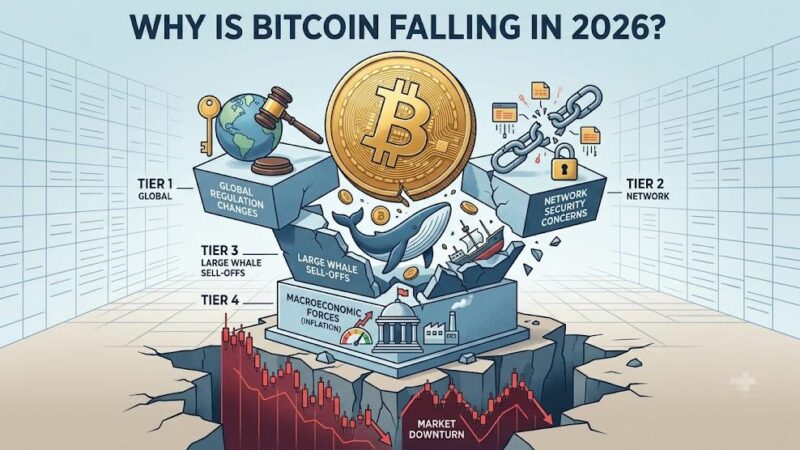
Bitcoin is falling in 2026 because the market is facing several headwinds at once. Spot Bitcoin ETF outflows are weakening demand, AI is attracting global capital, stablecoin liquidity has softened, and institutional confidence is being tested.
The key takeaway is that this is not just a Bitcoin chart problem. It is a market structure problem.
For readers following the crypto market, the most important signals now are ETF flows, liquidity conditions, Bitcoin’s reaction around $60,000, Ethereum’s ability to stabilize, and whether capital begins rotating back into digital assets.
Crypto is still alive, but the market is becoming more selective. In this environment, strong narratives are not enough. Investors want liquidity, confirmation and evidence that demand is returning.
This article is for market information and educational purposes only. It should not be considered financial advice.
FAQ
Why is Bitcoin falling in 2026?
Bitcoin is falling in 2026 because of heavy spot Bitcoin ETF outflows, weaker liquidity, macro uncertainty, reduced risk appetite and capital rotation toward AI-related investments.
Are Bitcoin ETF outflows bad for BTC?
Bitcoin ETF outflows can pressure BTC because they suggest weaker institutional demand. However, outflows may also reflect portfolio rebalancing, arbitrage activity or short-term risk management rather than a permanent loss of interest.
Why is AI affecting the crypto market?
AI is attracting massive investment from institutions, technology companies and infrastructure providers. When capital flows heavily into AI stocks, chips and data centers, crypto has to compete for investor attention and liquidity.
Is Bitcoin below $60,000 a bearish signal?
Bitcoin trading below or near $60,000 is an important psychological and technical signal. However, traders usually look for confirmation through volume, ETF flows, derivatives positioning and broader market liquidity before drawing stronger conclusions.
Could the crypto market recover in 2026?
A recovery is possible if ETF outflows slow, liquidity improves, stablecoin supply stabilizes and investors regain confidence in Bitcoin and Ethereum. Without those signals, rallies may remain short-lived.
Internal Link Suggestions
- Bitcoin ETF Outflows Explained: What They Mean for Crypto Investors
- Crypto Market Today: Bitcoin, Ethereum and Altcoins Under Pressure
- AI Stocks vs Crypto: Why Capital Is Moving Away From Digital Assets
- What Is Bitcoin Dominance and Why Does It Matter?
- Ethereum Price Outlook: Why ETH Is Struggling in 2026
Image Prompt
Create a realistic editorial-style image for a crypto market news article: a Bitcoin symbol on a digital trading screen showing a downward red chart, ETF flow data panels, AI chip graphics in the background, and a serious financial newsroom atmosphere. No people, no logos of real companies, modern dark blue and orange color palette, professional crypto news style, 16:9 aspect ratio.
Social Caption
Bitcoin is under pressure again in 2026. ETF outflows, weaker liquidity and the rise of AI-driven capital rotation are all weighing on crypto sentiment. Here’s what traders are watching as BTC struggles near the $60K level.
David Chen provides daily market analysis, price action breakdowns, and on-chain insights. He has been covering crypto markets since 2017.
The author may hold positions in cryptocurrencies discussed. Not financial advice.