AscendEX Shutdown: Crypto Exchange Ceases Operations as MiCA and Withdrawal Risks Hit Users
AscendEX has ceased operations as MiCA pressure, manual withdrawals and possible liquidity issues raise new counterparty-risk concerns for crypto users.
Key Takeaways
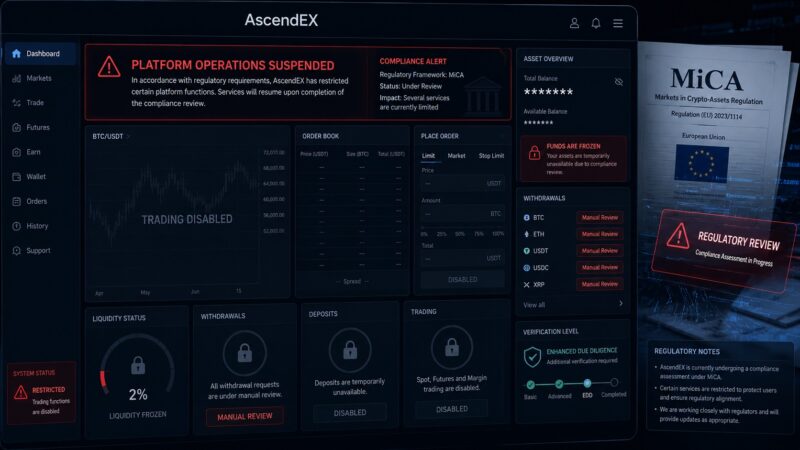
- AscendEX officially ceased operations effective July 1, 2026.
- The exchange cited MiCA authorization issues, along with broader regulatory, financial and operational considerations.
- Users can no longer open accounts, deposit assets, trade, swap, stake, lend or use other crypto services on AscendEX.
- As of July 6, all withdrawal requests are subject to manual review, and automated withdrawals are paused.
- AscendEX said withdrawals may be delayed, may require more information or may not be processed while reviews continue.
- Crypto reports have linked the shutdown to earlier warnings about withdrawal delays and depleted hot-wallet reserves, but those reserve claims should be treated as externally reported.
- The event highlights renewed counterparty risk across centralized exchanges as MiCA reshapes Europe’s crypto market.
- Users with funds on affected platforms should document balances, export transaction history and follow only official withdrawal channels.
AscendEX has officially ceased operations, creating a new wave of concern around centralized exchange risk, withdrawal delays and crypto regulation.
According to a notice published on the AscendEX website, the exchange **ceased operations effective July 1, 2026**. The company cited several factors, including the European Union’s Markets in Crypto-Assets Regulation, known as **MiCA**, under which AscendEX said it does not hold authorization. It also pointed to broader regulatory, financial and operational considerations affecting the platform.
For users, the impact is immediate.
AscendEX said customers can no longer open accounts, deposit assets, trade, swap, stake, lend, participate in referral campaigns or access other crypto-asset services. Account access is expected to remain available only for limited offboarding purposes, including withdrawal requests, KYC updates, complaints, support and transaction-history exports.
The shutdown is more than a single exchange story. It is another reminder that centralized crypto platforms can carry counterparty risk, especially when regulation, liquidity and operational pressure collide.
What Happened to AscendEX?
AscendEX announced that it had stopped operating as a crypto exchange from July 1, 2026.
The company’s official notice states that its decision was connected to MiCA developments in Europe, where the exchange does not hold the required authorization, as well as broader business and operational pressures.
The Defiant also reported that AscendEX ceased operations on July 1 and moved all withdrawal requests to manual review starting July 6. The report noted that customers can no longer use core services such as deposits, trading, swaps, staking or lending.
This means AscendEX is no longer functioning as a normal trading venue.
The platform is now effectively in wind-down mode, with account access limited to user exits, verification updates, complaint handling and record downloads.
Withdrawals Are Now Under Manual Review
The most important issue for users is withdrawals.
AscendEX said that as of July 6, 2026, **all withdrawal requests are subject to manual review** before processing. Automated withdrawals have been paused. The exchange said withdrawal requests will be reviewed based on legal, technical and operational requirements, including KYC/AML checks, sanctions screening, fraud prevention, balance reconciliation, network availability and possible insolvency-related requirements.
This is a major change because manual review can slow down user exits.
AscendEX also said withdrawals may be delayed, may require additional information, or may not be processed while the review continues. The company said it cannot currently give assurances about timing or amounts.
For users, this is the highest-risk part of the story.
When a centralized exchange pauses automated withdrawals and moves to manual review, users lose certainty over timing. They also become dependent on the platform’s internal reconciliation, compliance process and available liquidity.
Why MiCA Is Part of the Story
MiCA is the European Union’s comprehensive crypto-asset regulatory framework.
ESMA’s MiCA page explains that entities already providing crypto-asset services under national laws before December 30, 2024 could continue during the transitional phase until **July 1, 2026**, or until they were granted or refused MiCA authorization.
ESMA also issued a public statement before the deadline, saying unauthorized crypto-asset service providers were expected to take immediate steps to wind down EU activities in an orderly manner while safeguarding client interests and market integrity.
This provides the regulatory background for AscendEX’s announcement.
However, AscendEX’s shutdown should not be viewed only as a MiCA issue. The exchange itself also referenced broader financial and operational considerations. The Defiant reported that AscendEX said it had relied on a strategic transaction intended to provide liquidity, but the counterparty did not perform, leaving the platform to assess its financial position and possible options for account holders.
That makes the situation more serious than a simple licensing exit.
Reported Liquidity Concerns Add Pressure
Several crypto news reports have connected the shutdown to earlier warnings about withdrawal delays and hot-wallet reserves.
Crypto Briefing reported that on-chain investigator ZachXBT had warned on June 26 about withdrawal delays and depleted hot wallets before AscendEX shut down. The report said the exchange formerly operated as BitMax before rebranding to AscendEX in 2021.
Incrypted also reported that ZachXBT had documented user complaints about withdrawals delayed for days or weeks and that checks of known hot wallets suggested a near-total absence of major crypto assets such as ETH, USDT, USDC and SOL.
These reserve claims should be treated carefully because they come from external on-chain analysis and media reporting, not directly from a full audited proof-of-reserves statement by AscendEX.
Still, the reports are relevant because they help explain why users are worried.
When withdrawal delays, manual processing and reported low reserves appear together, market participants usually interpret the situation as a serious counterparty-risk event.
Why the AscendEX Shutdown Matters for Crypto Users
The AscendEX shutdown matters because it shows that exchange risk has not disappeared from crypto.
After the collapse of several centralized platforms in previous cycles, many users became more cautious about leaving assets on exchanges. But during calmer markets, some traders still treat centralized platforms like banks or long-term custody providers.
AscendEX is a reminder that an exchange account is not the same as a self-custody wallet.
When assets are held on a centralized exchange, users depend on the platform’s solvency, compliance, operational controls, withdrawal systems and legal structure. If the exchange enters wind-down mode, users may face delays even if their account balance appears correctly on the screen.
This is why the phrase “not your keys, not your coins” remains relevant.
It may sound repetitive, but events like this show why custody risk matters.
Centralized Exchange Risk Is Becoming More Regulatory
The AscendEX case also shows that centralized exchange risk is becoming more regulatory.
In earlier crypto cycles, exchange failures were often associated with hacks, fraud, leverage or poor internal controls. Those risks still exist. But in 2026, regulatory authorization is now a central operating requirement, especially in Europe.
MiCA has created a more formal licensing environment for crypto-asset service providers. Platforms that cannot obtain authorization may need to wind down services, restrict users or exit jurisdictions.
For larger exchanges, this may lead to more compliance spending and regional restructuring. For smaller or weaker platforms, it may accelerate consolidation or shutdowns.
This is important for users because an exchange can look functional until a licensing deadline, liquidity issue or regulatory event forces a sudden service change.
Could This Affect Broader Crypto Market Sentiment?
The AscendEX shutdown appears to be mostly platform-specific, but it can still affect broader sentiment.
When users see withdrawal restrictions or manual review processes, they often reassess where they keep assets. That can lead to more withdrawals from smaller centralized exchanges and more movement toward larger regulated platforms, self-custody wallets or on-chain venues.
This does not necessarily mean a broad market crash will follow.
However, it can temporarily weaken confidence in smaller exchanges and increase risk aversion, especially if users begin asking whether other platforms have similar licensing or liquidity problems.
The effect is most likely to be strongest in the CeFi sector rather than across Bitcoin or Ethereum directly.
What Users Should Do If They Have Funds on AscendEX
Users with funds on AscendEX should focus on documentation and official processes.
AscendEX’s notice tells users not to make new deposits, to review account balances, ensure KYC information is complete, submit withdrawal requests only through the official platform withdrawal flow, and download transaction history for records and tax reporting.
This is important because users may need clear records if withdrawals are delayed, partially processed or disputed.
A practical checklist includes:
“`text
Do not deposit any new funds.
Log in only through the official AscendEX website or app.
Take screenshots of account balances and pending withdrawals.
Download transaction history and tax records.
Complete any required KYC updates.
Submit withdrawal requests only through the official platform.
Save all support tickets, emails and complaint records.
Avoid Telegram, X or Discord accounts claiming they can “recover” funds.
Report unresolved issues to the relevant regulator in your jurisdiction.
“`
Users should be especially careful with recovery scams. Shutdown events often attract impersonators who pretend to be support staff, lawyers or recovery agents.
What Traders Should Watch Next
Traders should watch several signals over the coming days and weeks.
The first signal is withdrawal processing. If users begin confirming successful withdrawals, confidence may improve. If delays continue, concern may rise.
The second signal is any formal insolvency or restructuring announcement. AscendEX’s own notice references possible legal or insolvency-related constraints, so this remains a key risk.
The third signal is regulatory communication. If European regulators or other authorities issue statements, the market may get more clarity on how affected users will be treated.
The fourth signal is wallet movement. On-chain analysts will likely continue monitoring known AscendEX wallets for asset transfers.
The fifth signal is whether other exchanges face similar MiCA-driven restrictions. ESMA has already made clear that unauthorized providers must wind down EU activities after the transitional period.
The sixth signal is user migration. Assets may move from smaller exchanges to larger licensed platforms, self-custody wallets or decentralized venues.
Why This Is a Warning for Smaller Exchanges
AscendEX is not the first exchange to face pressure, and it will likely not be the last.
As crypto regulation matures, exchanges need stronger licensing, custody controls, compliance systems, proof-of-reserves practices and operational transparency. Smaller platforms may find it harder to meet these requirements while also maintaining liquidity and user trust.
This creates a structural shift in the industry.
The most regulated, liquid and transparent platforms may gain share. Smaller platforms with weak licensing, unclear reserves or limited operational runway may lose users or exit the market.
For crypto users, the lesson is clear: exchange selection matters.
Low fees, altcoin listings or promotional rewards are not enough. Users should also evaluate licensing status, withdrawal history, proof-of-reserves quality, jurisdiction, user complaints, custody structure and how quickly the platform responds during stress.
Near-Term Outlook
The near-term outlook for AscendEX users remains uncertain.
The exchange has stopped normal operations, paused automated withdrawals and moved all withdrawal requests to manual review. It has also said it cannot currently provide assurances about withdrawal timing or amounts.
That means users should expect delays and should preserve documentation.
For the broader market, the shutdown is a warning rather than a confirmed systemic shock. The most likely immediate impact is increased scrutiny of smaller centralized exchanges, especially those without clear MiCA authorization or strong liquidity transparency.
If withdrawals are processed in an orderly way, the event may remain contained. If users report persistent failures or if formal insolvency proceedings begin, the story could become a larger CeFi-risk event.
Final Thoughts
The AscendEX shutdown is one of the clearest examples of how regulation, liquidity and platform risk can converge in crypto.
The exchange has officially ceased operations effective July 1, 2026. It cited MiCA authorization issues and broader business pressures. Users can no longer trade, deposit, stake or use normal platform services. Withdrawals are now subject to manual review, with no guaranteed timing or amount.
This does not mean every centralized exchange is unsafe.
But it does mean users should take exchange counterparty risk seriously.
AscendEX’s shutdown reinforces three basic principles: do not leave unnecessary funds on trading platforms, verify the regulatory status of exchanges, and keep complete records of deposits, withdrawals and balances.
For crypto investors, the event is not just about one platform closing. It is a reminder that custody, liquidity and regulation are now central parts of market risk.
This article is for market information and educational purposes only. It should not be considered financial, legal or tax advice.
Internal Link Suggestions
- Europe Reviews MiCA Rules as Stablecoins and Tokenization Reshape Crypto Markets
- CLARITY Act July Push: Why U.S. Crypto Regulation Is Back in Focus
- July Token Unlocks Put PUMP in Focus as $776M Supply Wave Tests Crypto Liquidity
- Trump Memecoin Losses and Vector (VSG) Hype Show the Risk of Retail-Driven Crypto Narratives
- Bitcoin Price Faces Liquidity Shock as BTC Battles Key Technical Resistance