
AI and Blockchain in 2026: Hype, Real Utility or the Next Web3 Narrative?
AI and blockchain are becoming one of the most watched Web3 narratives in 2026 as tokenization, security, regulation and capital rotation reshape crypto markets.

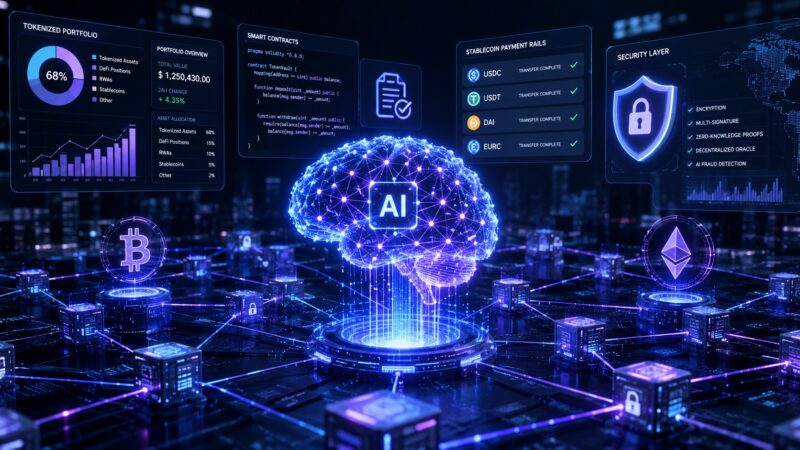
Key Takeaways
- AI and blockchain are becoming one of the most important Web3 narratives in 2026.
- AI has attracted major capital away from crypto, but analysts argue Bitcoin may still follow its post-halving recovery pattern.
- The strongest AI-blockchain use cases are likely to involve tokenization, data verification, automated payments, security and decentralized infrastructure.
- Tokenization is expanding beyond ETFs and bonds into personalized portfolio construction.
- Recent blockchain security incidents show that AI and automation cannot replace strong protocol-level security.
- Regulation remains a key factor as the CLARITY Act, MiCA and prediction market rules shape investor confidence.
- The AI-blockchain narrative may grow, but projects need real usage, liquidity and credible infrastructure to avoid becoming another hype cycle.
AI and blockchain are becoming one of the most discussed narratives in crypto.
The idea is attractive: artificial intelligence can automate decision-making, analyze markets, generate content, manage agents and process massive amounts of data. Blockchain can provide digital ownership, programmable payments, transparent settlement, tokenized assets and verifiable records.
Together, they sound like a natural fit.
But in 2026, investors are asking a more serious question: **is AI and blockchain the next major Web3 narrative, or is the market simply attaching AI branding to crypto projects because AI is attracting capital?**
That question matters because crypto is still recovering from a difficult market environment. Bitcoin has lagged record-high equities, ETF flows have been volatile, and capital has rotated aggressively toward AI and semiconductor themes. CoinDesk reported that researchers at Schwab and Hashdex believe AI has diverted capital from digital assets, even as Bitcoin continues to follow a familiar post-halving recovery pattern.
This creates a complicated setup. AI is one of the strongest investment themes in global markets, while blockchain is trying to prove where it fits inside that new digital infrastructure stack.
Why AI and Blockchain Are Becoming a Major Web3 Theme
The AI and blockchain narrative is growing because both technologies are focused on digital coordination.
AI can produce decisions, predictions and autonomous actions. Blockchain can record ownership, transfer value and verify transactions without relying on one central database. When combined properly, the two technologies could support new types of digital markets.
The most credible AI-blockchain use cases are not just about launching AI tokens. They involve practical infrastructure:
AI agents that can make stablecoin payments;
blockchain-based identity and permissions for automated systems;
tokenized data markets;
proof of data origin and content authenticity;
decentralized compute networks;
smart contracts that execute based on AI-driven signals;
portfolio automation and tokenized investment strategies;
security systems that detect abnormal blockchain behavior.
This is why the narrative is broader than “AI coins.” The real opportunity may be in infrastructure, not speculation.
AI Has Been Pulling Capital Away From Crypto
The main challenge for crypto is that AI is already winning the capital race.
Investors have been heavily focused on AI chips, data centers, cloud infrastructure and semiconductor stocks. That has made it harder for Bitcoin and digital assets to attract the same level of momentum capital.
CoinDesk reported that Bitcoin’s disconnect from record-high stocks may not last forever, but it also noted that AI has diverted capital from digital assets. Researchers cited by CoinDesk argued that Bitcoin’s slower rebound still fits a familiar post-halving recovery pattern.
This is important for the AI-blockchain narrative.
If AI continues attracting global capital, crypto projects that connect meaningfully to AI could benefit from investor attention. But projects with weak technology or unclear token utility may struggle because investors are becoming more selective.
In other words, AI can help crypto regain attention, but only if blockchain adds something useful.
The Market Is Moving From AI Hype to AI Utility
The first wave of AI crypto narratives was mostly speculative.
Many projects added AI language to their branding, even when blockchain was not clearly necessary. That may work during a strong bull market, but it is harder to sustain when liquidity is weak and investors are demanding proof.
The next phase is likely to focus on utility.
Investors will ask several questions:
Does the project need a blockchain?
Does the token have a real role?
Are there users beyond traders?
Is there revenue or measurable activity?
Can the system scale?
Is the data verifiable?
Is the protocol secure?
Does AI improve the product, or is it just marketing?
These questions are important because AI and blockchain are both powerful technologies, but combining them badly can create complexity without value.
Tokenization May Be the Strongest Bridge Between AI and Blockchain
One of the most practical blockchain narratives in 2026 is tokenization.
Tokenization turns assets such as stocks, bonds, funds, real estate or portfolios into blockchain-based representations. This can improve transferability, settlement, transparency and programmability.
CoinDesk reported that Thomas Sy, head of multi-asset solutions at New York Life Investment Management, said tokenization’s next use case could be personalized portfolios. According to the report, Sy argued that blockchain can enable complex portfolio construction that is not yet possible in traditional finance.
This is where AI and blockchain can become more interesting.
AI can help design personalized investment strategies. Blockchain can make those strategies programmable, transparent and easier to distribute. Tokenized portfolios could eventually combine automated allocation, real-time rebalancing, stablecoin settlement and on-chain reporting.
That would be a more serious use case than simply launching another AI-themed token.
Personalized Portfolios Could Become a Web3 Finance Use Case
Personalized portfolios are important because they show how blockchain may support financial products that are difficult to build with traditional infrastructure.
In traditional finance, highly customized strategies are usually expensive and operationally complex. They often require manual administration, transfer agents, custodians, fund accounting systems and settlement processes.
Blockchain could reduce some of that friction by embedding ownership and transfer logic into tokenized assets.
AI could add another layer by helping design, monitor and adjust strategies based on investor preferences, risk tolerance, market signals and liquidity conditions.
This does not mean every portfolio should move on-chain. But it does suggest that AI and blockchain could work together in areas where customization, transparency and automation matter.
Blockchain Security Is Still a Major Risk
The AI-blockchain narrative also has a serious risk: security.
AI can help detect vulnerabilities, monitor transactions and automate audits, but it cannot eliminate protocol risk. Smart contracts, consensus systems, bridges and wallets can still fail.
CoinDesk reported that ethical hackers using a $3,000 server found a critical flaw in the Aptos blockchain that could have put about $70 billion in crypto at risk. The vulnerability was patched, and researchers said their simulated attack path had a near-90% success rate at breaking a core security guarantee.
This is a reminder that blockchain infrastructure must be secure before advanced AI use cases can scale.
If AI agents are going to hold assets, make payments, trade tokens or interact with smart contracts, the underlying systems need strong security assumptions. Otherwise, automation could increase the speed and scale of losses.
Security is therefore not a side issue. It is central to whether AI and blockchain can become a serious Web3 infrastructure theme.
AI Agents Need Reliable Payment Rails
One of the clearest AI-blockchain use cases is payments for AI agents.
If autonomous AI agents become more common, they may need to pay for APIs, data, compute, software tools, storage, subscriptions or digital services. Traditional payment rails are not always designed for machine-to-machine transactions, especially at small scale or across borders.
Stablecoins and blockchain wallets could solve part of this problem.
An AI agent could hold a wallet, receive stablecoins, pay for services, execute smart contract transactions and maintain a transparent transaction history. This would make blockchain useful as a settlement layer for automated digital activity.
However, this also raises questions about identity, permissions, fraud, limits, compliance and liability.
Who is responsible if an AI agent makes a bad transaction?
How can users revoke permissions?
How can platforms prevent malicious agents?
How should compliance systems treat machine-controlled wallets?
These questions show why the AI-blockchain narrative is connected to both technology and regulation.
Regulation Is Still a Market Driver
The AI and blockchain narrative is developing while crypto regulation is becoming more important.
In the U.S., the CLARITY Act remains a major policy focus. CoinDesk reported that all parties remain optimistic that the CLARITY Act can happen before the midterms, but time is starting to run out as Congress moves toward its summer break.
Regulatory clarity matters for AI and blockchain because many use cases involve financial activity. Tokenized portfolios, AI-managed wallets, prediction markets, decentralized compute payments and on-chain derivatives all require legal frameworks.
If regulation is unclear, institutions may hesitate to build products. If rules become clearer, more serious companies may enter the market.
This is why Web3 investors should not separate technology from policy. AI-blockchain products may depend as much on regulatory permission as on technical capability.
Prediction Markets Show the Legal Complexity of On-Chain Information Markets
Prediction markets are another area where AI, blockchain and regulation overlap.
AI can analyze data and generate forecasts. Blockchain can support transparent markets around outcomes. Prediction markets can turn information into tradable probabilities.
But the legal environment is complicated.
Reuters reported that a Michigan judge blocked Kalshi from allowing residents to place sports bets after state officials accused the platform of violating gaming laws. Kalshi argued that it falls under federal CFTC jurisdiction rather than state gaming rules.
The broader dispute shows how difficult it is to regulate event-based markets. Are they financial markets, gambling products, forecasting tools or something else?
For AI and blockchain, this matters because automated forecasting and on-chain markets could become more powerful. But if legal definitions remain unclear, growth may be limited by compliance risk.
Why Blockchain Still Matters in an AI-Dominated Market
It is easy to assume AI will absorb all investor attention and leave crypto behind. But blockchain still solves a different set of problems.
AI creates outputs. Blockchain creates records.
AI generates decisions. Blockchain settles transactions.
AI can automate behavior. Blockchain can define ownership and permissions.
AI can predict. Blockchain can verify and execute.
This distinction is important.
The future may not be AI versus blockchain. It may be AI systems using blockchain rails for payments, identity, asset ownership, audit trails and market coordination.
That is the strongest version of the AI-blockchain thesis.
Where AI and Blockchain Could Create Real Value
The strongest opportunities may appear in five areas.
First, **payments for AI agents**. Stablecoins could support machine-to-machine payments and automated digital commerce.
Second, **tokenized financial products**. AI can personalize strategies, while blockchain can distribute and settle them.
Third, **data provenance**. Blockchain can help verify where data, content or model outputs came from.
Fourth, **decentralized compute and storage**. Blockchain incentives may support alternative compute networks, though they must prove they can compete with centralized providers.
Fifth, **security and monitoring**. AI can help identify suspicious patterns, while blockchain provides transparent transaction data for analysis.
These areas are more credible than vague claims that every AI project needs a token.
Why Many AI Crypto Projects May Still Fail
The AI-blockchain sector will likely produce winners, but many projects may fail.
Some projects will not need a token. Others will not have enough users. Some will be unable to compete with centralized AI infrastructure. Others may face security problems, poor liquidity or unclear regulation.
The biggest risk is that investors chase the narrative rather than the product.
A project calling itself “AI-powered” is not enough. The key question is whether blockchain improves the system in a way that could not be achieved more easily with traditional databases, cloud infrastructure or normal payment rails.
If the answer is no, the token may be mostly speculative.
What Traders Are Watching Now
Traders are watching several signals to judge whether the AI-blockchain narrative is becoming real.
The first signal is capital rotation. If AI-related equities remain dominant, crypto needs stronger reasons to attract risk capital back.
The second signal is AI token relative strength. If AI-linked crypto assets outperform Bitcoin, Ethereum and other sectors during market stress, the narrative may be gaining traction.
The third signal is tokenization adoption. Institutional activity around tokenized portfolios, tokenized securities and stablecoin settlement may show that blockchain is becoming useful in financial infrastructure.
The fourth signal is security. Major vulnerabilities or exploits can damage confidence in blockchain infrastructure, especially if AI agents and automated systems are expected to use it.
The fifth signal is regulation. CLARITY Act progress, MiCA implementation and prediction market litigation can all affect how AI-blockchain products develop.
The sixth signal is real usage. Developer activity, users, transaction volume, revenue and integrations matter more than social media hype.
Is AI and Blockchain the Next Web3 Narrative?
AI and blockchain could become one of the next major Web3 narratives, but only if the sector moves beyond branding.
The opportunity is real. AI systems may need payments, identity, ownership, verification and automation infrastructure. Blockchain can provide some of those tools.
But the market will likely separate real infrastructure from weak token stories.
The strongest AI-blockchain projects will probably be those that solve specific problems: how agents pay, how data is verified, how portfolios are tokenized, how computation is coordinated, how automated systems are audited and how digital assets are secured.
The weakest projects will be those that use AI as a marketing label without showing why blockchain is needed.
Near-Term Outlook
The near-term outlook for AI and blockchain depends on liquidity, regulation and proof of adoption.
If crypto markets stabilize and capital begins rotating back from AI equities into digital assets, AI-linked Web3 projects could attract renewed attention. If Bitcoin remains weak and ETF flows stay volatile, speculative AI tokens may struggle to sustain momentum.
Tokenization may be the most durable part of the narrative because it connects blockchain to real financial infrastructure. AI agents and decentralized compute may have higher upside, but they also require more technical proof.
For now, investors should treat AI and blockchain as an early but important narrative.
It has real potential, but the market still needs evidence.
Final Thoughts
AI and blockchain are not automatically the future of Web3, but the intersection is too important to ignore.
AI is changing how digital systems create decisions, predictions and automation. Blockchain is changing how digital systems transfer value, verify ownership and coordinate markets.
The strongest opportunity appears where these two functions overlap.
In 2026, the AI-blockchain narrative is still being tested. Tokenization, personalized portfolios, AI agent payments, data provenance and security monitoring are promising areas. But hype remains a major risk.
For investors and readers, the best approach is to separate narrative from utility.
A real AI-blockchain project should have users, infrastructure, liquidity, security and a clear reason for using blockchain. Without those elements, the project may be part of the hype cycle rather than the next Web3 growth story.
This article is for market information and educational purposes only. It should not be considered financial advice.
FAQ
What does AI and blockchain mean?
AI and blockchain refers to the combination of artificial intelligence systems with blockchain infrastructure for payments, identity, tokenization, data verification, decentralized compute, security and automated smart contract activity.
Why are AI and blockchain connected?
AI can create decisions and automation, while blockchain can provide value transfer, ownership records, programmable payments and transparent settlement. These functions can complement each other in Web3 applications.
Is AI and blockchain just hype?
Some AI-blockchain projects are hype-driven, but the broader theme has real potential. The strongest use cases involve tokenization, AI agent payments, data provenance, decentralized infrastructure and security.
How can blockchain help AI agents?
Blockchain can help AI agents by providing wallets, stablecoin payments, smart contract access, transaction records and permission systems for automated digital activity.
Why is tokenization important for AI and blockchain?
Tokenization can make assets programmable and easier to settle. AI could help personalize portfolios and automate strategies, while blockchain can handle ownership, transfer and settlement.
What are the risks of AI-blockchain projects?
Risks include weak token utility, poor security, limited adoption, unclear regulation, low liquidity and projects using AI branding without meaningful blockchain integration.
What should investors watch next?
Investors should watch AI token performance, tokenization adoption, stablecoin payment growth, security incidents, developer activity, regulatory updates and whether capital rotates back from AI equities into crypto.
Internal Link Suggestions
- AI and Crypto in 2026: Hype or the Next Big Blockchain Narrative?
- Crypto Macro Outlook 2026: Liquidity, ETF Flows and Bitcoin’s Cycle Risk
- CLARITY Act July Push: Why U.S. Crypto Regulation Is Back in Focus
- Europe Reviews MiCA Rules as Stablecoins and Tokenization Reshape Crypto Markets
- Open USD Stablecoin Explained: Why Big Tech and Wall Street Are Entering Crypto Payments
David Chen provides daily market analysis, price action breakdowns, and on-chain insights. He has been covering crypto markets since 2017.
The author may hold positions in cryptocurrencies discussed. Not financial advice.