
Solana, Sui and Aptos: The Fierce Battle of High-Performance Layer-1 Blockchains
Solana, Sui and Aptos are competing for Layer-1 dominance as throughput, latency, stablecoin liquidity and ecosystem traction shape the next altcoin cycle.

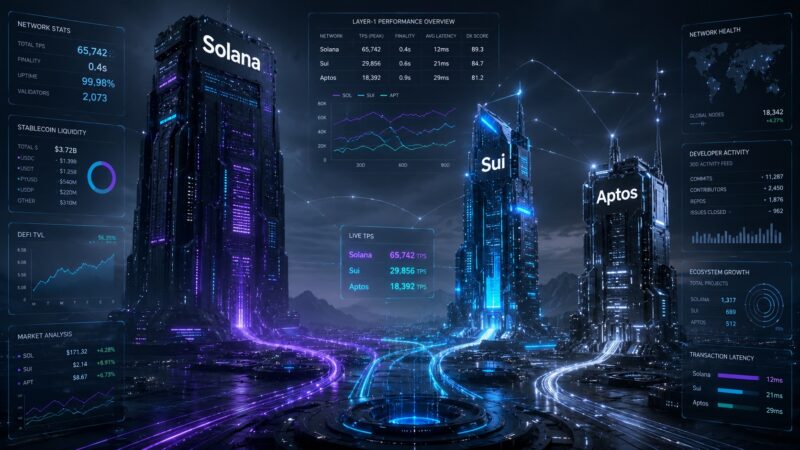
Key Takeaways
- Solana remains the dominant high-performance Layer-1 among SOL, SUI and APT by market cap, liquidity and application activity.
- Sui is showing stronger relative traction than Aptos in market value, DeFi usage and stablecoin liquidity.
- Aptos still has strong technical architecture, but its market valuation and ecosystem traction remain far behind Solana and Sui.
- The Layer-1 battle is no longer only about theoretical TPS; it is about users, liquidity, developers, applications and market depth.
- Solana’s Firedancer and Alpenglow upgrades remain key catalysts for improving resilience and reducing latency.
- Sui’s object-centric architecture gives it a strong technical identity, but token supply overhang remains a major risk.
- Aptos shows that advanced technology alone does not guarantee valuation growth without strong network effects.
- Investors should watch stablecoin supply, DEX volume, active users, upgrade delivery and whether applications create durable demand.
The Layer-1 market is entering one of its most competitive phases yet.
After years of experimentation, the battle is no longer only about which blockchain claims the highest theoretical throughput. In 2026, investors are judging Layer-1 platforms by a tougher set of metrics: real users, stablecoin liquidity, DeFi activity, developer traction, network reliability, application diversity and whether the token captures durable value.
That is why **Solana, Sui and Aptos** are becoming one of the most important comparisons in the altcoin market.
All three networks position themselves around performance. Solana is built around high-throughput execution and a rapidly expanding application ecosystem. Sui uses an object-centric architecture designed for parallel execution and asset-centric programmability. Aptos uses Move and Block-STM parallel execution to support fast settlement and scalable smart contract activity.
But the market is not rewarding all three equally.
Solana remains the dominant chain by liquidity, market capitalization and application traction. Sui is becoming the stronger challenger among Move-based networks. Aptos still has credible technology, but its market position remains weaker because liquidity, developer attention and application demand have not scaled at the same pace.
Layer-1 Competition Has Moved Beyond TPS
During earlier crypto cycles, Layer-1 blockchains often competed on theoretical throughput.
Projects claimed faster transaction speeds, lower fees and better consensus designs. Those metrics still matter, but they are no longer enough.
A Layer-1 can be technically impressive and still fail to attract users. It can process transactions quickly and still lack sticky applications. It can have low fees and still struggle to build deep liquidity. It can have advanced architecture and still underperform if market makers, developers and users do not treat it as a primary ecosystem.
This is the key lesson from Solana, Sui and Aptos in 2026: **performance is necessary, but network effects decide valuation**.
Investors now want to see whether speed converts into DeFi liquidity, stablecoin usage, application revenue, active addresses and durable ecosystem demand.
Solana Still Leads the High-Performance Layer-1 Race
Solana remains the clear leader among the three.
CoinMarketCap lists Solana at around $81 per SOL, with a market capitalization above $47 billion and 24-hour trading volume near $2.8 billion. That gives Solana far deeper liquidity and broader market recognition than Sui or Aptos.
DefiLlama data also shows Solana’s ecosystem depth. The chain has more than $15 billion in stablecoin market capitalization, nearly $2 billion in 24-hour DEX volume and more than $9 million in 24-hour fees paid across tracked activity.
These numbers matter because Solana’s valuation is not only based on its technology. It is supported by actual market activity.
Solana has become a major venue for DeFi, memecoin trading, tokenized assets, payments experiments, DePIN projects and consumer crypto applications. That gives SOL a much stronger ecosystem base than most other high-performance Layer-1 competitors.
Solana’s Technical Catalyst: Firedancer and Alpenglow
Solana’s biggest near-term catalysts are infrastructure upgrades.
Firedancer is one of the most important. It is an independent validator client developed by Jump Crypto. The goal is to improve Solana’s performance and resilience by reducing dependence on a single validator-client codebase. Firedancer documentation describes the validator as still under heavy development and beta software, which means expectations should be balanced against rollout risk.
Alpenglow is another major upgrade. Solana’s official network-upgrade page describes Alpenglow as a consensus protocol that aims to bring roughly 150ms confirmation times to Solana while simplifying the existing mechanism and improving reliability.
These upgrades matter because Solana’s biggest historical criticism has been reliability. If Firedancer improves client diversity and Alpenglow reduces latency while strengthening consensus design, Solana’s high-performance narrative becomes more credible.
That could support a higher valuation multiple if the upgrades are delivered smoothly and ecosystem activity remains strong.
Solana’s Risk: High Activity Does Not Mean Low Risk
Solana’s strength is also a source of risk.
Because Solana is cheap, fast and highly active, it has become a major venue for memecoins and speculative token launches. That drives volume, fees and attention, but it also exposes users to scams, market manipulation and short-lived trading cycles.
Recent academic research on Solana rug pulls found that the network’s low barrier to token issuance has contributed to widespread fraudulent launches. A large-scale study of more than 100,000 newly issued Solana tokens in the first half of 2025 identified more than 76,000 as rug-pull tokens, according to the authors’ detection system.
This does not mean Solana is weak. It means Solana’s open and high-speed environment creates both strong growth and high-risk speculation.
For investors, the question is whether Solana’s serious use cases — DeFi, tokenization, payments, DePIN and institutional activity — can grow faster than the reputational risks created by speculative token cycles.
Sui Is the Stronger Move-Based Challenger
Sui is the more compelling challenger among the two Move-based platforms.
CoinGecko shows Sui trading around $0.74, with a market capitalization close to $3 billion and a circulating supply of about 4.1 billion SUI.
DefiLlama data shows Sui with more than $461 million in stablecoin market capitalization, about $39.7 million in 24-hour DEX volume and more than 14 million transactions over 24 hours.
These numbers are far below Solana, but they are meaningful for a smaller ecosystem. Sui has enough liquidity and activity to remain relevant, while its technical design gives it a distinct identity.
The key difference between Sui and Aptos is not simply technology. It is market traction. Sui has built a stronger relative narrative around user-facing applications, DeFi growth, gaming, payments and fast asset movement.
Sui’s Object-Centric Architecture Is Its Core Advantage
Sui’s biggest technical advantage is its object-centric model.
Sui documentation explains that every resource, asset or piece of on-chain data is structured as an object with a unique ID, owner and version number. This differs from account-based blockchain models where storage is typically organized around account key-value stores.
This design matters because it can make certain types of transactions easier to parallelize. When assets are treated as objects, independent transactions can be processed without forcing every operation through the same global bottleneck.
For user-facing applications, this can be important. Games, NFTs, payments, consumer apps and asset-heavy systems may benefit from a model where objects are first-class primitives.
Sui’s technical identity is therefore not just “another fast chain.” It is a chain built around programmable objects and parallel execution.
Sui’s Main Risk: Token Supply Overhang
Sui’s biggest market risk is token supply.
CoinGecko’s tokenomics data shows that SUI has a total supply of 10 billion tokens, with about 4.05 billion currently unlocked and circulating. It also shows more than 5.2 billion SUI classified as locked TBD and another 733 million SUI still locked.
This matters because future unlocks can create selling pressure.
Even if Sui’s technology and ecosystem continue improving, investors may discount the token if they believe future supply expansion will pressure price. A strong ecosystem can absorb unlocks, but only if demand grows fast enough.
For SUI, the key question is whether application activity, DeFi liquidity and stablecoin usage can expand faster than token supply enters the market.
Aptos Has Strong Technology, But Weaker Market Traction
Aptos remains technically credible, but its market position is much weaker.
CoinMarketCap lists Aptos around $0.64, with a market capitalization close to $533 million and a circulating supply of about 833 million APT.
DefiLlama data shows Aptos with about $1.9 billion in stablecoin market capitalization, more than $11 million in 24-hour DEX volume and roughly 105,000 active addresses over 24 hours.
The stablecoin figure is notable, but Aptos still lacks the same market attention, trading activity and application depth as Solana. It also trails Sui in token valuation and public ecosystem momentum.
This creates a difficult situation. Aptos has advanced technology, but the market has not yet rewarded it with a large valuation premium.
Aptos and Block-STM: Strong Architecture, Limited Narrative Power
Aptos’s strongest technical feature is Block-STM.
Block-STM is a parallel execution engine for smart contracts. Its research paper describes how transactions can be grouped into blocks and executed speculatively in parallel while preserving deterministic outcomes. The evaluation reported throughput improvements of up to 170,000 TPS in Aptos benchmarks under test conditions.
That is impressive architecture.
However, markets do not value architecture in isolation. Investors want to see how technical capability translates into users, liquidity, applications, fees and ecosystem growth.
This is where Aptos has struggled. Its technology is strong, but its narrative has not been as powerful as Solana’s consumer-crypto momentum or Sui’s object-centric ecosystem story.
For Aptos to re-rate, it needs a stronger application category that clearly proves why developers and users should choose Aptos over Solana, Sui, Ethereum L2s or other high-performance chains.
Move Is Powerful, But It Is Not a Guarantee
Both Sui and Aptos use Move-derived programming environments, but their trajectories show that programming language alone does not determine market success.
Move is designed around safer asset handling and resource-oriented programming. That is attractive for financial applications and token logic. But the ecosystem still needs builders, liquidity and distribution.
Aptos-related research on Move runtime safety notes that Move programs execute in a sandboxed VM and are statically verified for foundational safety properties, while also emphasizing that complex static verification logic is not immune to bugs and requires defense-in-depth runtime safety checks.
This is an important point for investors.
Technical safety is valuable, but it does not remove execution risk. Blockchain ecosystems still need protocol security, application audits, liquidity incentives, developer tooling, market makers and user demand.
Comparison Table: Solana vs Sui vs Aptos
Comparison Table: Solana vs Sui vs Aptos
| Metric | Solana | Sui | Aptos |
|---|---|---|---|
| Token | SOL | SUI | APT |
| Market Position | Dominant high-performance L1 | Strong Move-based challenger | Technically strong but smaller ecosystem |
| Approx. Market Cap | ~$47.3B | ~$3.0B | ~$533M |
| Approx. Token Price | ~$81 | ~$0.74 | ~$0.64 |
| Stablecoin Market Cap | ~$15.1B | ~$461M | ~$1.9B |
| 24H DEX Volume | ~$2.0B | ~$39.7M | ~$11.2M |
| Core Architecture | High-throughput pipeline, Firedancer, Alpenglow | Object-centric Move model | Move, Block-STM parallel execution |
| Main Catalyst | Firedancer, Alpenglow, DePIN, tokenization, consumer apps | DeFi growth, object model, gaming, payments | Technical re-rating, institutional apps, Move tooling |
| Main Risk | Speculation, memecoin risk, reliability expectations | Token unlock overhang | Weak network effects and smaller app traction |
Solana’s lead is clear in market cap, DEX volume and stablecoin liquidity, while Sui has a stronger relative position than Aptos in public market valuation and ecosystem narrative. Aptos still has meaningful stablecoin liquidity, but its lower valuation and weaker DEX volume show that liquidity alone does not guarantee a stronger market position.
Why Stablecoin Liquidity Matters
Stablecoin liquidity is one of the most important metrics in the Layer-1 battle.
A chain with deep stablecoin liquidity can support DeFi, payments, trading, lending, on-chain treasury activity and market-maker operations. Without stablecoin depth, applications may struggle to scale because users do not have enough reliable dollar-denominated liquidity.
Solana’s stablecoin supply above $15 billion gives it a major advantage. It means the ecosystem has deep settlement liquidity for DeFi and trading activity.
Sui’s stablecoin base is much smaller but still meaningful for its market size. DefiLlama lists Sui stablecoin market capitalization above $461 million, which supports its growing DeFi ecosystem.
Aptos has a surprisingly large stablecoin base relative to its token market cap, with DefiLlama showing roughly $1.9 billion in stablecoin market cap. But its DEX volume and active application layer remain weaker, which suggests that stablecoin supply has not yet translated into the same level of organic ecosystem momentum.
Why Solana’s Ecosystem Is Hard to Catch
Solana’s advantage is not just performance. It is distribution.
The chain has already attracted traders, app developers, wallet users, DePIN projects, NFT communities, memecoin users and institutional experiments. Once an ecosystem reaches a certain scale, liquidity and developers reinforce each other.
More users attract more apps. More apps attract more liquidity. More liquidity attracts more market makers. More market makers improve execution. Better execution attracts more traders.
That flywheel is difficult for smaller Layer-1s to copy.
Sui and Aptos can compete technically, but they need breakout applications that create durable reasons for users to stay.
Why Sui Could Still Gain Ground
Sui has a credible path to gaining ground because it is not trying to be a direct Solana clone.
Its object-centric architecture gives it a different design philosophy, especially for asset-heavy applications. If gaming, NFTs, payments, consumer applications or real-world asset systems require more flexible object ownership and parallel execution, Sui could build a unique niche.
The market is already treating Sui as a more serious contender than Aptos based on current valuation. But the next stage depends on whether Sui can grow actual usage while managing token unlock concerns.
If Sui’s DeFi liquidity, stablecoin supply and application activity continue expanding, it could remain one of the strongest altcoin narratives among non-Ethereum Layer-1s.
Why Aptos Needs a Stronger Narrative
Aptos needs a clearer market narrative.
Its technical stack is strong. Block-STM, Move and sub-second latency are credible. The problem is that the market has seen many fast blockchains before.
To reprice higher, Aptos needs one or more breakout categories.
That could be institutional tokenization, on-chain order books, gaming, AI agents, payments or enterprise settlement. But the use case needs to be visible in user activity, transaction quality, fees, DEX volume and developer growth.
Without that, Aptos risks being viewed as a technically advanced chain without enough demand.
The Main Lesson for 2026
The Solana, Sui and Aptos comparison reveals one of the most important lessons in crypto:
**Core technology does not automatically create network value.**
Solana is winning because performance has turned into liquidity, users and applications. Sui is gaining attention because its architecture is differentiated and its ecosystem has enough traction to stay relevant. Aptos shows that strong technical design still needs market depth, narrative strength and application pull.
This matters for the entire Layer-1 sector.
The next altcoin cycle will likely reward chains that combine strong infrastructure with clear usage. The market may punish chains that only offer theoretical speed without visible adoption.
What Investors Are Watching Next
Investors are watching several signals across Solana, Sui and Aptos.
The first signal is stablecoin supply. Rising stablecoin liquidity can show that users and market makers are preparing to transact on-chain.
The second signal is DEX volume. High DEX volume suggests real trading demand and deeper market participation.
The third signal is active addresses and transaction quality. Raw transaction counts can be inflated, so investors should focus on meaningful activity tied to applications.
The fourth signal is developer momentum. Strong developer ecosystems create more experiments and more chances for breakout apps.
The fifth signal is upgrade delivery. Solana’s Firedancer and Alpenglow roadmap will be important for its reliability narrative.
The sixth signal is token supply. Sui’s unlock profile and Aptos’s token economics can affect valuation even if ecosystems improve.
The seventh signal is application category leadership. The winning Layer-1s will likely dominate specific use cases rather than compete only on generic speed.
Near-Term Outlook
The near-term outlook favors Solana, but Sui remains the stronger challenger.
Solana has the deepest liquidity, the strongest market recognition and the clearest ecosystem flywheel. If Firedancer and Alpenglow improve resilience while Solana’s DeFi, tokenization and consumer app activity continue growing, SOL could remain the leading high-performance Layer-1 narrative.
Sui has a more asymmetric setup. Its valuation is far smaller than Solana’s, but its technical differentiation and growing ecosystem give it room to compete if adoption continues. The main risk is token supply overhang.
Aptos has the most difficult setup. It has credible technology and meaningful stablecoin liquidity, but the market needs stronger proof that the ecosystem can generate durable demand.
For now, Solana is the leader, Sui is the challenger, and Aptos is the technical underdog.
Final Thoughts
The Layer-1 battle between Solana, Sui and Aptos is not just a fight over speed.
It is a fight over liquidity, users, applications, developer mindshare and market structure.
Solana has already built the strongest network effects among high-performance Layer-1s. Sui is proving that a differentiated architecture can still attract attention in a crowded market. Aptos shows that advanced technical design needs a stronger ecosystem to translate into valuation.
In 2026, investors should focus less on theoretical TPS claims and more on real adoption signals.
The most important question is not which chain is fastest. It is which chain can turn performance into sustained economic activity.
This article is for market information and educational purposes only. It should not be considered financial advice.
Internal Link Suggestions
- Ethereum Rebound Meets Massive Binance Outflows
- Bitcoin Price Faces Liquidity Shock as BTC Battles Key Technical Resistance
- AI and Blockchain in 2026: Hype, Real Utility or the Next Web3 Narrative?
- Crypto Macro Outlook 2026: Liquidity, ETF Flows and Bitcoin’s Cycle Risk
- Europe Reviews MiCA Rules as Stablecoins and Tokenization Reshape Crypto Markets
David Chen provides daily market analysis, price action breakdowns, and on-chain insights. He has been covering crypto markets since 2017.
The author may hold positions in cryptocurrencies discussed. Not financial advice.