July Token Unlocks Put PUMP in Focus as $776M Supply Wave Tests Crypto Liquidity
July’s second week brings over $776 million in crypto token unlocks, led by Pump.fun’s 82.5 billion PUMP release. Here’s why traders are watching volatility risk.
Key Takeaways
- July’s second week is set to bring more than $776 million in crypto token unlocks.
- Pump.fun leads the week with 82.5 billion PUMP scheduled to unlock on July 12.
- The PUMP unlock is valued around $134 million to $135 million, depending on token price estimates.
- Several trackers estimate the PUMP unlock at about 29% of released or circulating supply, making it the key volatility event of the week.
- Aptos and RedStone also have scheduled unlocks, but their dollar values are much smaller than PUMP’s.
- Token unlocks do not automatically cause sell-offs, but they increase available supply and can pressure thin liquidity.
- Traders should watch exchange deposits, DEX liquidity, post-unlock volume and whether recipients sell, hold or stagger distribution.
Crypto traders are turning their attention to **July token unlocks** as a major supply wave approaches the market.
The second week of July 2026 is expected to release more than **$776 million** worth of tokens into circulation, with **Pump.fun (PUMP)** standing out as the largest and most watched event. BeInCrypto reported that token unlocks worth over **$776.3 million** are scheduled for the week, led by PUMP, Aptos and RedStone.
For investors, this matters because token unlocks can change the short-term supply structure of an asset. When previously locked tokens become tradable, holders may sell, hold, stake or move the tokens into liquidity pools. The market impact depends on how much supply enters circulation, who receives it, how deep the order books are and whether demand is strong enough to absorb the new tokens.
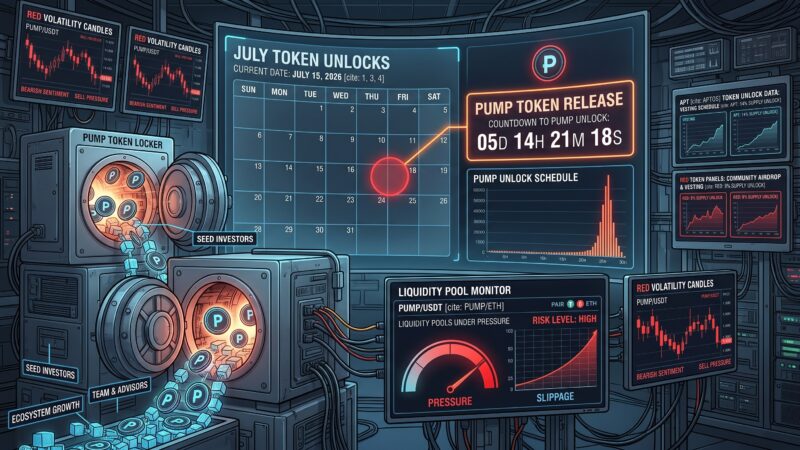
The main focus this week is PUMP. Pump.fun is scheduled to unlock **82.5 billion PUMP tokens** on July 12, with estimates placing the release around **$134 million to $135 million**.
That makes the event one of the most important altcoin supply tests of the month.
Why Token Unlocks Matter for Crypto Markets
A token unlock is a scheduled event where previously restricted tokens become transferable or tradable.
These tokens are often allocated to early investors, team members, contributors, advisors, foundations or ecosystem funds. Unlock schedules are common because they prevent all tokens from entering the market at once. But when a large unlock happens, traders pay close attention.
The reason is simple: **new supply can create selling pressure if recipients decide to sell.**
That does not mean every unlock causes a price drop. Some recipients may hold tokens long term. Some may stake. Some may provide liquidity. Some projects may have strong demand that absorbs the extra supply. But when the unlock is large relative to circulating supply or market liquidity, volatility risk rises sharply.
This is why July’s second week matters. The unlock calendar is not just a background tokenomics detail. It is a direct market structure event.
PUMP Leads the July Unlock Watchlist
Pump.fun is the main event.
BeInCrypto reported that Pump.fun will unlock **82.5 billion PUMP** on July 12. The release is estimated at approximately **$134.65 million** and represents **29.23% of the released supply**. The article also notes that the team is set to receive **50 billion PUMP**, while existing investors will receive **32.5 billion PUMP**.
CryptoRank’s syndicated Tokenomist-based data shows a similar setup, estimating the PUMP unlock at **82.5 billion tokens**, worth about **$133.74 million**, or **29.23% of circulating supply**.
Because market estimates vary with token price and circulating-supply methodology, the safest framing is that PUMP is facing an unlock of roughly **82.5 billion tokens**, valued near **$134 million to $135 million** at recent prices.
That is a large release for any altcoin, especially one tied to a highly speculative memecoin launchpad narrative.
Pump.fun’s Unlock Is a Liquidity Test, Not Just a Supply Event
The PUMP unlock is important because it tests whether real liquidity can absorb a large one-day supply increase.
DEXTools published an on-chain analysis estimating that the July 12 PUMP unlock is worth roughly **$135 million**, while total on-chain liquidity across major PUMP pools was around **$16 million** at the time of its review. The same analysis estimated that the unlock is about **eight times larger than total PUMP pool liquidity** and that the project’s buyback pace was around **$3.9 million per week**.
This does not mean $135 million of PUMP will definitely be sold.
Unlocked tokens are not automatically market-sold tokens. Recipients may choose to hold, stagger sales or use tokens in ecosystem activity. But the liquidity mismatch matters because it shows how sensitive the token could become if even a fraction of unlocked supply moves toward the market.
In thin liquidity conditions, price can move sharply with relatively small sell pressure.
Why PUMP’s Buyback Narrative Is Under Scrutiny
PUMP bulls often point to the project’s buyback-and-burn mechanism as a structural support for the token.
The idea is that Pump.fun revenue can be used to buy PUMP on the open market and remove supply. That can create a recurring bid for the token and reduce circulating pressure over time.
However, the July 12 unlock raises a timing problem.
DEXTools estimated that the buyback clears around **2.4 billion PUMP per week**, while the unlock releases **82.5 billion PUMP in one day**. At that pace, the buyback would need roughly **35 weeks** to repurchase the equivalent of the one-day unlock, assuming similar conditions.
This is why traders are not only asking whether PUMP has a buyback. They are asking whether the buyback is large enough and fast enough to absorb a cliff unlock.
The answer depends on post-unlock behavior. If recipients do not sell heavily, the impact may be manageable. If tokens move quickly to exchanges or pools, the buyback may not be enough to prevent volatility.
Aptos and RedStone Also Face New Supply
PUMP is the largest unlock, but it is not the only event this week.
BeInCrypto reported that **Aptos (APT)** will unlock **11.31 million APT** on July 12, worth about **$7.15 million**, representing **0.66% of released supply**. The allocation includes tokens for core contributors, community, investors and the foundation.
RedStone (RED) is also scheduled to unlock **40.85 million RED** on July 6, worth about **$4.16 million**, representing **9.8% of released supply**. The distribution includes early backers, core contributors, ecosystem and data providers, and protocol development.
CryptoRank’s Tokenomist-based summary reports similar figures, listing RED on July 6, APT on July 12 and PUMP on July 12 as the key weekly unlocks.
Compared with PUMP, the APT and RED unlocks are smaller in dollar terms. However, percentage-of-supply matters. A smaller dollar unlock can still affect price if liquidity is thin or if the unlocked amount is large relative to the token’s float.
Why Traders Are Searching for Token Unlocks in July
Search demand around token unlocks usually rises when traders expect volatility.
Unlock calendars help investors manage risk because they show when new supply may enter the market. This is especially useful in altcoin markets, where prices can be more sensitive to tokenomics than Bitcoin or Ethereum.
Traders use token unlock data to answer several questions:
Which tokens face new supply this week?
How large is the unlock relative to circulating supply?
Who receives the tokens?
Are recipients likely to sell?
Is there enough liquidity to absorb selling?
Are market makers preparing for volatility?
Is price already pricing in the unlock?
This is why the topic is highly relevant in July. The market is still fragile, and investors are looking for ways to hedge against sudden altcoin moves.
Token Unlocks Do Not Always Mean Price Will Fall
A common mistake is assuming every token unlock causes an automatic dump.
The market reaction is more nuanced.
Some tokens fall before the unlock because traders front-run expected selling. In those cases, price may stabilize after the event if the actual selling pressure is smaller than feared.
Some tokens rise into the unlock if demand is strong or if investors expect the newly released tokens to support ecosystem growth.
Some tokens sell off after the unlock if recipients quickly move tokens to exchanges.
Some tokens remain flat if liquidity is deep enough to absorb the supply.
For PUMP, the risk is elevated because the unlock is large and liquidity appears relatively shallow compared with the release size. But the final impact still depends on what recipients do with the unlocked tokens.
How to Read Unlock Risk Properly
The best way to analyze unlock risk is to separate **supply**, **liquidity** and **recipient behavior**.
Supply tells traders how many tokens become available.
Liquidity tells traders how easily the market can absorb buying or selling.
Recipient behavior tells traders whether the new supply is likely to hit the market.
For PUMP, the supply number is large. The liquidity picture looks thin based on on-chain pool analysis. Recipient behavior is uncertain.
That combination creates volatility risk.
For APT, the unlock is smaller relative to released supply, which may reduce immediate pressure. For RED, the dollar amount is smaller, but the percentage of released supply is more notable.
This is why traders should avoid treating all unlocks equally.
Pump.fun’s Market Context Adds More Risk
PUMP’s unlock is also important because Pump.fun sits inside one of crypto’s most speculative sectors: Solana memecoin launchpads.
Pump.fun has been one of the most visible platforms for memecoin creation, but memecoin activity is volatile by nature. Academic research analyzing more than 832,000 Pump.fun token launches between May and June 2026 found that only about **0.198%** of launches graduated within 24 hours, showing how difficult it is for most new tokens to gain durable traction.
That matters for PUMP because the token’s value narrative is tied to platform activity.
If Pump.fun revenue remains strong, buybacks and ecosystem confidence may improve. If launch activity weakens or user attention moves elsewhere, PUMP may face both supply pressure and weaker demand.
This is why the July 12 unlock is not just a tokenomics event. It is also a test of whether Pump.fun’s platform economics can support its token during a major supply expansion.
What Traders Are Watching Before July 12
Traders are watching several signals before the PUMP unlock.
The first signal is price behavior into the event. If PUMP falls sharply before July 12, some selling pressure may already be priced in. If PUMP rallies into the unlock, the risk of a post-event reversal may increase.
The second signal is DEX liquidity. If liquidity deepens before the unlock, the market may be better prepared to absorb supply.
The third signal is exchange deposits. If newly unlocked tokens move to exchanges, that may suggest higher sell-side risk.
The fourth signal is wallet behavior. If team or investor wallets hold tokens after the unlock, volatility may be lower than expected.
The fifth signal is buyback pace. If revenue-funded buybacks accelerate, the market may become more confident that supply pressure can be partially absorbed.
The sixth signal is broader altcoin sentiment. If risk appetite is weak, unlocks can have a stronger negative impact.
What Traders Are Watching After July 12
The most important period may be the first 24 to 72 hours after the unlock.
If PUMP holds support and volume remains controlled, traders may interpret the event as a successful supply absorption. That could create a relief bounce if too many traders were positioned for downside.
If PUMP breaks support on rising volume, the market may conclude that unlock recipients are selling or that liquidity is not deep enough.
If tokens move slowly and pool liquidity remains stable, the unlock may have less immediate impact than feared.
If large transfers hit exchanges or DEX pools, volatility could accelerate quickly.
The key point is that the unlock itself is only the start of the data. The real signal comes from what happens after tokens become liquid.
Why This Matters Beyond PUMP
The July unlock schedule matters beyond one token because it affects broader altcoin risk appetite.
When multiple tokens unlock in the same week, traders may reduce exposure to smaller or less liquid assets. That can create broader pressure across altcoins, especially if Bitcoin and Ethereum are also facing resistance.
At the same time, unlock events can create opportunities for traders who specialize in volatility. Some may hedge before unlocks, trade post-event relief, or look for mispriced tokens where the market overestimates sell pressure.
This is why unlock calendars are useful. They help investors anticipate where volatility may concentrate.
Near-Term Outlook
The near-term outlook for July token unlocks is cautious.
The PUMP unlock is the main event because of its size, timing and liquidity mismatch. The release of 82.5 billion tokens valued around $134 million to $135 million is large enough to influence short-term price action, especially if newly liquid tokens move toward trading venues.
Aptos and RedStone also deserve attention, but their unlocks are less dominant in dollar terms.
For PUMP, the key question is whether the market can absorb the unlock without a disorderly move. That will depend on recipient behavior, liquidity depth, buyback activity and broader altcoin sentiment.
If sell pressure is lower than expected, PUMP could stabilize after the event. If sell pressure is higher than expected, the unlock could become a major volatility trigger.
Final Thoughts
July’s second-week token unlocks are becoming a major focus for crypto traders because they create clear supply events during an already sensitive market period.
PUMP is the key token to watch. The July 12 unlock of **82.5 billion PUMP** is valued near **$134 million to $135 million**, and multiple sources estimate it at roughly **29% of released or circulating supply**.
That does not guarantee a sell-off, but it does raise volatility risk.
The most important takeaway is that unlocks should be analyzed through liquidity, not only headline value. A $135 million unlock has a very different market impact if liquidity is deep versus thin. In PUMP’s case, on-chain analysis suggests pool liquidity may be much smaller than the unlock size, which makes post-unlock behavior especially important.
For investors, July token unlocks are not just calendar events. They are risk-management signals.
Watch the unlock dates, monitor wallet movement, track exchange deposits, check DEX liquidity and avoid assuming that every unlocked token will be sold immediately. The market impact will depend on actual flows, not only scheduled supply.
This article is for market information and educational purposes only. It should not be considered financial advice.
Internal Link Suggestions
- Plasma (XPL) Gains Attention as Plasma One Card Fuels Stablecoin Payment Narrative
- Trump Memecoin Losses and Vector (VSG) Hype Show the Risk of Retail-Driven Crypto Narratives
- Solana, Sui and Aptos: The Fierce Battle of High-Performance Layer-1 Blockchains
- Bitcoin Price Faces Liquidity Shock as BTC Battles Key Technical Resistance
- Crypto Macro Outlook 2026: Liquidity, ETF Flows and Bitcoin’s Cycle Risk