
Are Vietnamese Investors Required to Trade Through Licensed Domestic Crypto Exchanges?
Vietnam is moving toward a licensed domestic crypto exchange model. Here’s what Vietnamese investors need to know about trading, offshore platforms and regulation.

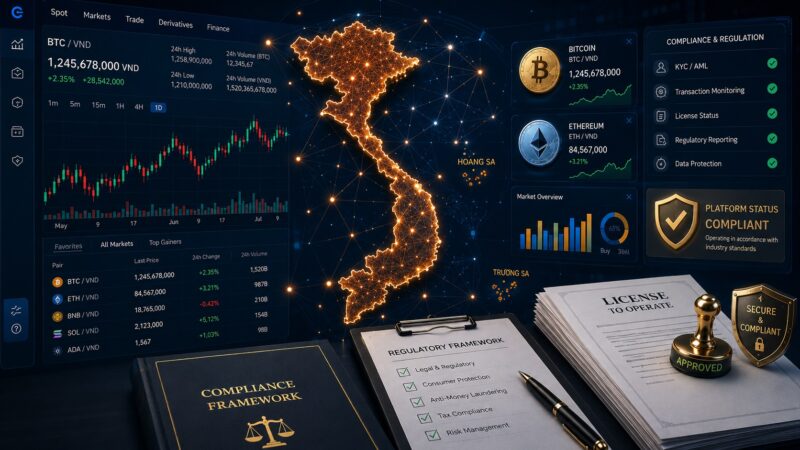
Key Takeaways
- id="54geoi"
- Vietnam is moving toward a regulated crypto market built around licensed domestic exchanges.
- Vietnamese investors may be required to trade through Ministry of Finance-licensed crypto asset service providers once the pilot framework is fully implemented.
- The new rules are designed to improve oversight, investor protection, tax collection and capital-flow control.
- Offshore crypto platforms may face tighter restrictions as Vietnam develops its domestic exchange system.
- Crypto ownership is gaining clearer legal recognition, but crypto is still not treated as legal tender in Vietnam.
- Tokenized assets and regulated trading platforms are becoming a global policy focus, not only a Vietnam-specific issue.
- Investors should watch licensing timelines, approved exchanges, tax rules and official regulatory guidance before making decisions.
Vietnam is moving into a new phase of crypto regulation.
For years, Vietnamese crypto investors mostly traded through offshore platforms such as Binance, OKX, Bybit and other global exchanges. The market was active, but the legal environment remained unclear. Crypto ownership was not fully banned, but trading, custody, taxation and investor protection operated in a gray area.
That is now changing.
Vietnam has introduced a pilot regulatory framework for crypto asset trading, and the direction is clear: regulators want crypto activity to move from offshore platforms into licensed domestic exchanges. Reuters reported that Vietnam is preparing to curb trading on overseas crypto platforms while local companies compete to launch the country’s first government-approved crypto exchanges.
For investors, the key question is simple: **are Vietnamese investors required to trade through licensed domestic exchanges?**
The practical answer is: **Vietnam is moving toward that requirement, but investors should watch the exact implementation timeline, the first licensed exchange date and official guidance from regulators.**
Vietnam Is Building a Licensed Crypto Market
Vietnam’s crypto market has become too large for regulators to ignore.
Reuters reported that Vietnam ranked fourth globally in Chainalysis’ Global Crypto Adoption Index and that transactions involving Vietnamese traders exceeded $200 billion in the 12 months to June. That scale explains why the government is trying to bring crypto trading into a supervised framework.
The goal is not simply to ban crypto. Instead, Vietnam appears to be building a controlled market where licensed domestic platforms handle trading, custody, settlement, compliance and investor protection.
Under Vietnam’s pilot crypto asset market program, only enterprises licensed by the Ministry of Finance are allowed to organize crypto asset exchanges, operate issuance platforms or market related products. The framework also requires compliance with anti-money laundering, counter-terrorism financing, cybersecurity and data protection rules.
This marks a major shift from informal offshore trading to regulated domestic infrastructure.
Are Vietnamese Investors Required to Use Licensed Domestic Exchanges?
Under Resolution 05/2025/NQ-CP, domestic investors who already hold crypto assets and foreign investors may open accounts with crypto asset service providers licensed by Vietnam’s Ministry of Finance to custody, buy and sell crypto assets in Vietnam. The resolution also states that, after six months from the date the first licensed crypto asset service provider is granted a license, domestic investors who trade crypto assets outside licensed providers may face administrative penalties or criminal liability depending on the nature and severity of the violation.
This is the most important point for Vietnamese investors.
The rule is structured around the launch of licensed service providers. That means investors need to monitor when the first domestic exchange is officially licensed and when the six-month transition period begins.
In simple terms, Vietnam is creating a pathway where crypto trading is expected to move through licensed domestic exchanges rather than unlicensed offshore platforms.
Why Vietnam Wants Domestic Crypto Exchanges
Vietnam’s policy direction reflects several regulatory goals.
The first goal is investor protection. When users trade on offshore platforms, Vietnamese regulators have limited ability to supervise custody, withdrawals, market manipulation, customer complaints or disputes. Licensed domestic platforms give regulators more control over how customer assets are held and how risks are managed.
The second goal is financial oversight. Crypto trading can involve large capital flows, stablecoins and cross-border transfers. Reuters noted that Vietnamese authorities have concerns about cryptocurrencies and stablecoins because of risks linked to uncontrolled capital outflows.
The third goal is tax collection. A regulated domestic market makes it easier to track transactions, apply tax rules and reduce informal trading activity.
The fourth goal is market development. Domestic exchanges could help Vietnam keep transaction fees, jobs, technology investment and financial innovation inside the country.
The fifth goal is anti-money laundering control. Licensed platforms can be required to implement KYC, transaction monitoring, cybersecurity systems and reporting procedures.
Crypto Is Recognized, But Not as Legal Tender
Vietnam’s regulatory shift does not mean Bitcoin or other crypto assets become money.
RMIT Vietnam noted that the Law on Digital Technology Industry, set to take effect on January 1, 2026, gives crypto assets clearer legal recognition and introduces definitions for “virtual assets” and “crypto assets.” However, Reuters reported that digital assets are not recognized as money or legal means of payment in Vietnam.
This distinction is important.
Crypto assets may be recognized for ownership, investment or regulated trading purposes, but that does not mean they can be used freely as legal currency for payments. Vietnamese investors should separate these concepts carefully.
Ownership recognition does not automatically equal payment legality.
What the Pilot Framework Covers
Vietnam’s five-year pilot framework covers the offering, issuance, trading and service provision of crypto assets.
According to LuatVietnam, Resolution 05/2025/NQ-CP establishes a five-year pilot program and requires issuance, trading and payment activities involving crypto assets to be conducted in Vietnamese dong. It also states that only Ministry of Finance-licensed enterprises may organize digital asset exchanges or operate related platforms.
The framework includes strict requirements for operators. Licensed service providers need substantial capital, governance systems, risk management procedures, technology infrastructure, cybersecurity controls and qualified personnel.
Tilleke & Gibbins reported that Vietnam’s Ministry of Finance issued Decision No. 96/QD-BTC on January 20, 2026 to launch pilot administrative procedures for licensing crypto asset trading market services. The Ministry of Finance is responsible for reviewing and deciding on licenses, while the State Securities Commission acts as the receiving and coordinating focal point.
That shows the licensing framework is not theoretical. Vietnam has started building the administrative process for domestic crypto exchange operators.
Offshore Exchanges May Face More Pressure
The biggest market impact may come from restrictions on offshore platforms.
Reuters reported that Vietnam’s finance ministry was drafting rules that would prohibit Vietnamese nationals from trading on overseas crypto platforms. It also noted that most Vietnamese traders currently use offshore centralized exchanges because the domestic market had not yet had licensed alternatives.
This creates a transition problem.
Vietnamese investors may currently hold assets on offshore platforms, but the regulatory direction suggests they may eventually need to move activity into licensed domestic channels once the pilot system becomes operational.
This does not mean every investor should immediately move assets without planning. Instead, investors should follow official announcements, confirm which exchanges are licensed, review custody and withdrawal procedures, and understand any tax or reporting requirements.
Why This Matters for Bitcoin, Ethereum and Altcoin Traders
The shift toward licensed domestic exchanges could affect how Vietnamese investors access Bitcoin, Ethereum and major altcoins.
If domestic platforms are limited in the assets they can list, traders may have fewer available tokens compared with global exchanges. Regulators may prioritize large-cap assets, compliant products or specific asset classes during the pilot stage.
Liquidity may also be different. Offshore exchanges often have deeper global order books and derivatives markets. Domestic exchanges may start with lower liquidity, fewer trading pairs and more conservative rules.
However, licensed domestic platforms may offer advantages such as clearer legal protection, local customer support, easier VND settlement, tax reporting and stronger regulatory oversight.
For long-term investors, that trade-off may be acceptable. For active traders, the shift could change execution, fees, spreads and available products.
The Global Context: Tokenized Assets Are Becoming Regulated
Vietnam’s move is part of a larger global trend.
Regulators around the world are no longer treating crypto as a fringe market. They are building rules for stablecoins, exchanges, tokenized securities, custody and real-world asset markets.
Securitize recently tokenized about $295 million of its own stock on Solana and Avalanche during its NYSE debut, while Ondo Finance launched tokenized versions of BlackRock’s IVV ETF and Micron shares under a U.S. regulatory-aligned model. These developments show that tokenization is moving closer to regulated capital markets rather than remaining only a crypto-native experiment.
Europe is also revisiting its crypto framework. CoinDesk reported that MiCA is now under review through a process often described as “MiCA 2.0,” with policymakers examining whether the framework remains fit for a fast-changing market.
This global context matters for Vietnam. As tokenized assets, crypto exchanges and digital asset services become more institutionalized, domestic regulators are likely to demand more licensing, supervision and investor protection.
What Vietnamese Investors Should Watch
Vietnamese investors should watch several signals over the coming months.
The first signal is the list of approved exchanges. Investors should confirm which platforms receive official licenses from the Ministry of Finance before assuming any domestic exchange is compliant.
The second signal is the first-license date. Under the pilot rules, the six-month transition period is linked to the date the first licensed provider receives approval.
The third signal is offshore exchange restrictions. If Vietnam formally blocks or restricts access to unlicensed foreign platforms, investors may need to adjust custody and trading plans.
The fourth signal is tax guidance. The pilot framework points toward tax treatment, but investors should wait for detailed rules on reporting, gains, losses, transfers and business activity.
The fifth signal is asset availability. Not every token listed globally may be available on licensed Vietnamese platforms.
The sixth signal is custody protection. Investors should review how domestic platforms store assets, handle withdrawals and protect users in case of operational failure.
What This Means for Crypto Businesses
For crypto businesses, Vietnam’s shift creates both opportunity and pressure.
The opportunity is that Vietnam has one of the most active crypto user bases in the world. A licensed exchange model could create demand for custody, compliance software, wallet infrastructure, analytics, cybersecurity, tax reporting and blockchain education.
The pressure is that compliance costs will be high. Operators must meet capital, governance, AML, cybersecurity and system-safety requirements. This may favor banks, securities firms and large financial groups over smaller startups.
Vietnam News reported that Vietnam began accepting license applications for crypto asset exchanges from January 20, 2026 under new administrative procedures, and that several securities firms and banks had announced plans to participate once licensed.
That suggests the domestic crypto market may develop through regulated financial institutions rather than purely crypto-native startups.
Could This Reduce Crypto Market Volatility?
Licensed exchanges alone will not remove crypto volatility.
Bitcoin, Ethereum and altcoins will still react to global liquidity, ETF flows, macro policy, derivatives positioning and market sentiment. However, regulated domestic exchanges may reduce some operational risks for local investors.
For example, domestic licensing could improve dispute resolution, custody standards, fiat settlement, user identification and regulatory supervision. It could also reduce the legal uncertainty that has surrounded crypto trading in Vietnam for years.
But investors should not confuse regulatory oversight with investment safety. Crypto prices can still fall sharply, even on licensed platforms.
Near-Term Outlook
The near-term outlook depends on how quickly Vietnam completes the licensing process and how strictly it enforces offshore restrictions.
If licensed domestic exchanges launch smoothly, Vietnam could become one of Southeast Asia’s most important regulated crypto markets. That would support the country’s broader digital finance strategy and potentially attract more institutional blockchain activity.
If implementation is delayed or rules remain unclear, investors may continue using offshore platforms while waiting for more certainty.
For now, the direction is clear: Vietnam wants crypto trading to move into a licensed, domestic and supervised framework.
Final Thoughts
Vietnamese investors should take the licensed-exchange transition seriously.
Vietnam is not simply ignoring crypto anymore. It is creating a formal pilot market, licensing procedures and a framework that may require domestic investors to trade through Ministry of Finance-approved service providers after a transition period.
The key issue is timing. Investors need to follow official licensing announcements, understand when the six-month period begins, and avoid assuming that offshore trading will remain unchanged.
For the broader crypto market, Vietnam’s move reflects a global trend: crypto is becoming more regulated, more institutional and more connected to traditional finance.
The market is moving away from a gray-zone model and toward controlled infrastructure. For Vietnamese investors, that could mean more protection — but also more compliance.
This article is for market information and educational purposes only and should not be considered legal, tax or financial advice.
FAQ
Are Vietnamese investors required to trade through licensed domestic crypto exchanges?
Vietnam is moving toward that requirement. Under Resolution 05/2025/NQ-CP, domestic investors who trade crypto assets outside Ministry of Finance-licensed service providers after the applicable transition period may face penalties depending on the violation.
When does the domestic exchange requirement apply?
The key trigger is the first licensed crypto asset service provider. The resolution refers to a six-month period after the first licensed provider is granted a license. Investors should follow official announcements to know when that timeline begins.
Can Vietnamese investors still own crypto?
Vietnam’s new digital asset framework gives crypto assets clearer legal recognition, but crypto is still not treated as legal tender. Ownership and trading rules should be understood separately from payment rules.
Will Vietnam ban offshore crypto exchanges?
Reuters reported that Vietnam was drafting rules to prohibit Vietnamese nationals from trading on overseas crypto platforms. Investors should monitor official regulatory announcements before making decisions.
Why is Vietnam creating licensed crypto exchanges?
Vietnam wants stronger oversight, investor protection, tax collection, anti-money laundering controls, cybersecurity standards and better management of capital flows.
What should Vietnamese crypto investors do now?
Investors should monitor official license approvals, review custody arrangements, prepare for possible offshore platform restrictions, follow tax guidance and avoid relying only on social media rumors.
Internal Link Suggestions
- Open USD Stablecoin Explained: Why Big Tech and Wall Street Are Entering Crypto Payments
- Are Bitcoin ETFs Still Driving the Crypto Market in 2026?
- Bitcoin Near $60K: Is This a Bottom or Another Bear Market Trap?
- What Are Tokenized Assets and Why Are They Important?
- Crypto Regulation in 2026: Why Global Rules Are Changing
Emma Rodriguez leads the educational content team at CoinPulseNews. She creates beginner-friendly guides that help new crypto users navigate the market safely.
The author may hold BTC. Content is educational only.