XRP Divergence Signal: Binance Scarcity Index Hits Two-Year High as Price Stalls Near $1.10
XRP’s Binance Scarcity Index has surged to a two-year high while price remains trapped near $1.10. Here’s why traders are watching supply, whales and short-squeeze risk.

Key Takeaways
- XRP’s Binance Scarcity Index has reportedly climbed to about 0.77, its highest level in roughly two years.
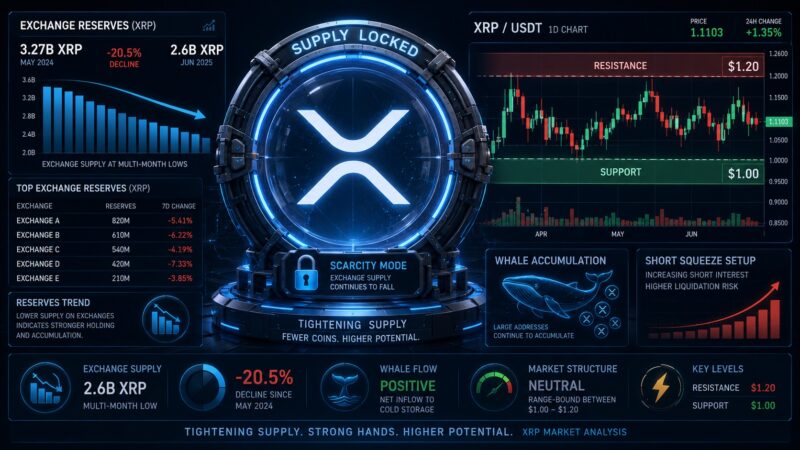
- Binance XRP reserves have fallen sharply, with multiple reports pointing to a decline toward the 2.6 billion XRP area.
- The key divergence is that exchange supply is shrinking while XRP price remains stuck near the $1.03–$1.14 range.
- Lower exchange reserves can reduce sell-side liquidity, but they do not guarantee an immediate breakout.
- A large leveraged XRP long position worth about $16.3 million has added attention to the short-squeeze narrative.
- The $1.00 level remains the key psychological support zone, while $1.20 is the next major resistance to watch.
- XRP needs stronger spot demand, volume confirmation and broader altcoin rotation to turn scarcity into price momentum.
XRP is showing one of the most unusual microstructure signals in the altcoin market.
While the broader crypto market continues to react to macro data, Bitcoin liquidity, ETF flows and regulatory headlines, XRP has developed a more specific on-chain divergence: exchange supply appears to be tightening, but price remains stuck near the same range.
That makes the current XRP setup especially important for traders.
The **XRP Binance Scarcity Index** has reportedly surged to around **0.77**, reaching its highest level in roughly two years. At the same time, Binance XRP reserves have continued to decline, with reports showing reserves near the **2.6 billion XRP** area after a sharp drop from late-2024 levels.
Normally, shrinking exchange reserves can be interpreted as a bullish supply signal. It may suggest that holders are moving tokens into cold wallets, custody solutions or long-term storage instead of keeping them available for immediate sale.
But XRP’s price action is not confirming that signal yet.
At the time of writing, XRP is trading near **$1.06**, still close to the lower part of its recent trading range.
This creates the core market question: **is XRP quietly building pressure for a breakout, or is the scarcity signal being overstated while demand remains weak?**
XRP’s Supply Signal Is Getting Harder to Ignore
The most important development is the decline in exchange supply.
CryptoQuant data cited by several market reports shows that Binance XRP reserves have fallen significantly. One recent CryptoQuant update said Binance XRP reserves declined from roughly **2.78 billion XRP on May 12 to 2.61 billion XRP on July 2**, a drop of around 170 million XRP in less than two months.
Other reports point to a larger structural decline since November 2024, when Binance reportedly held around **3.27 billion XRP**. Current reserve estimates near the **2.6 billion XRP** area suggest a decline of roughly **20%**, or about **650 million XRP**.
This is not a small move.
When a large exchange holds fewer tokens, the immediately tradable supply on that venue becomes thinner. If demand rises while available supply is lower, price can react more aggressively.
That is the bullish interpretation behind the XRP scarcity narrative.
What the XRP Binance Scarcity Index Means
The XRP Binance Scarcity Index attempts to measure how scarce XRP has become on Binance relative to historical conditions.
A higher reading generally suggests that available exchange supply is tightening. A lower reading suggests that more XRP is available on the platform.
Recent reports say the index has climbed to about **0.77**, its highest level in more than two years.
This matters because Binance remains one of the most important global crypto venues. Exchange balances on Binance can influence liquidity, trading depth, short-term price discovery and derivatives sentiment.
However, the index should not be treated as a perfect price signal.
A scarcity index can show supply conditions, but it does not prove demand. Tokens can leave an exchange for many reasons: self-custody, institutional custody, OTC settlement, DeFi use, transfer to another venue or risk management.
That is why the current divergence is important. XRP supply appears tighter, but price has not yet broken out in a convincing way.
The Main Divergence: Scarcity Is Rising, But Price Is Stuck
The most confusing part of the XRP setup is the gap between supply and price.
If Binance reserves are falling and the scarcity index is rising, traders might expect XRP to move sharply higher. Instead, XRP has remained trapped around the **$1.03–$1.14** range.
CoinDesk recently reported that XRP moved modestly higher near $1.06 while large-holder activity strengthened and new wallet creation reached a three-month high. However, the token still needed to reclaim the **$1.10** area before the recovery looked convincing.
This is the key problem for bulls.
Supply is tightening, but the market is not yet showing strong enough spot demand to turn that supply signal into a clean breakout.
In simple terms: **XRP looks scarce on Binance, but buyers have not yet taken control of the chart.**
Why Shrinking Exchange Supply Can Be Bullish
Shrinking exchange supply can be bullish because it reduces the number of tokens that can be sold quickly.
If large holders withdraw XRP from Binance into cold wallets or custody, those tokens may be less likely to hit the order book immediately. That can reduce sell-side pressure.
This type of setup can become powerful when combined with new demand.
A low-supply market can behave like dry tinder. If demand suddenly increases, even a modest wave of buying can trigger a larger price move because there are fewer tokens available for sale.
That is why traders are watching XRP closely.
If Bitcoin stabilizes, altcoin risk appetite improves and XRP sees renewed buying volume, the reduced exchange supply could amplify the move.
Why the Signal Can Also Be Misleading
The bearish counterargument is that exchange outflows do not always mean accumulation.
XRP leaving Binance may reflect long-term holding, but it may also reflect custody changes, exchange-risk management, internal wallet restructuring or movement to other platforms.
The market needs to know whether tokens are leaving because investors want to hold XRP, or because traders are simply shifting where they keep it.
This is why price confirmation matters.
A true accumulation signal should eventually appear in price behavior: higher lows, rising volume, stronger spot bids and a break above resistance.
Without those signals, the scarcity index alone may not be enough.
Derivatives Markets Are Adding Short-Squeeze Risk
The derivatives market is also adding attention to the XRP setup.
A recent report said a crypto whale sold **52.67 BTC**, worth about **$3.26 million**, and used the proceeds to open a **20x leveraged long position** of about **14.189 million XRP**, valued near **$16.3 million**, on HyperLiquid.
This type of trade is important for sentiment, but it is also risky.
A large leveraged long can signal conviction, especially when it appears near a major support zone. But 20x leverage also means the position is vulnerable to a relatively small adverse move.
If XRP rises, the position may reinforce the bullish narrative and attract copycat traders. If XRP falls, liquidation risk can add pressure to the downside.
This is why whale positioning should be treated carefully. It can be a signal, but it can also become a source of volatility.
The $1.00 Level Is the Line Bulls Must Defend
The most important support zone for XRP is still **$1.00**.
This level is both psychological and structural. When XRP trades above $1.00, traders can argue that the market is still defending a major base. If XRP loses $1.00 decisively, the bullish scarcity thesis becomes much weaker in the short term.
The $1.00 zone also matters because recent reports suggest that shorts were flushed near this area before bulls began watching the $1.20 resistance region.
For XRP bulls, the ideal structure is simple:
XRP holds above $1.00;
price reclaims $1.10;
volume expands;
exchange reserves continue falling;
XRP tests $1.20 resistance.
Without this sequence, the setup remains incomplete.
The $1.20 Resistance Is the Breakout Test
The next key resistance is **$1.20**.
This level matters because it represents the next structural test after XRP stabilizes above $1.10. Several recent market reports have identified $1.20 as the level bulls need to challenge if scarcity and exchange outflows begin translating into price momentum.
A clean break above $1.20 would change the market structure.
It would suggest that buyers are finally using the lower exchange supply to push price higher. It could also force bearish traders to cover positions, adding fuel to a short squeeze.
But failure at $1.20 would keep XRP trapped inside a broader range.
That would reinforce the idea that supply is tightening, but demand remains insufficient.
Why XRP Needs Altcoin Rotation
XRP’s breakout potential also depends on broader altcoin conditions.
Even strong coin-specific signals can fail if the overall market is weak. If Bitcoin dominance rises and capital stays concentrated in BTC, altcoins can struggle to outperform. If Ethereum, Solana, XRP and other large-cap altcoins begin moving together, the probability of an XRP breakout improves.
This is why XRP traders are watching Bitcoin and Ethereum as much as XRP itself.
A broader altcoin rotation would make the Binance scarcity signal more powerful. It would mean capital is moving back into higher-beta assets, giving XRP a better chance to break resistance.
Without that rotation, XRP may remain range-bound even with lower exchange reserves.
Whale Activity Supports the Accumulation Narrative
Large-holder activity is one of the strongest arguments for the bullish case.
CoinDesk reported that XRP saw stronger whale activity and a rise in new wallet creation, although retail traders remained cautious and price action still needed a stronger reclaim of $1.10.
This is consistent with the broader scarcity story.
If whales are accumulating while retail traders remain cautious, XRP may be in a stealth accumulation phase. That type of structure can precede a breakout, but only if demand eventually becomes visible in price and volume.
The risk is that whale activity can be misunderstood. Large wallets may accumulate, distribute, hedge or move assets for reasons not visible from basic flow data.
That is why price confirmation remains the final test.
XRP’s Market Structure Is Compressed
The XRP chart is compressed between two major zones.
Support sits around $1.00–$1.03. Resistance sits around $1.10–$1.20.
This type of compression can create sharp moves when price finally breaks out of the range. Reduced exchange supply can make the move even more aggressive if demand appears suddenly.
But compression works both ways.
If XRP breaks above resistance, the scarcity narrative may trigger stronger bullish momentum. If XRP breaks below support, the market may conclude that falling exchange reserves were not enough to support price.
The setup is therefore attractive, but not risk-free.
What Traders Are Watching Now
Traders are watching several signals to judge whether XRP’s scarcity setup is real.
The first signal is the XRP Binance Scarcity Index. If it remains elevated, traders may continue viewing Binance supply as tight.
The second signal is Binance XRP reserves. A continued decline toward or below 2.6 billion XRP would support the exchange-supply contraction thesis.
The third signal is the $1.00 support level. Bulls need to defend this area to avoid a deeper breakdown.
The fourth signal is the $1.10 reclaim. XRP needs to hold above this zone before the recovery becomes more credible.
The fifth signal is the $1.20 resistance test. A clean breakout would turn the scarcity signal into a stronger price signal.
The sixth signal is derivatives leverage. Large long positions can amplify upside, but they can also create liquidation risk.
The seventh signal is altcoin rotation. XRP is more likely to move if capital flows beyond Bitcoin and into large-cap altcoins.
Scarcity Alone Is Not Enough
The most important lesson from this setup is that scarcity alone does not create a breakout.
Supply contraction can improve the conditions for a move, but demand is still required. If buyers do not step in, price can remain flat even as exchange balances decline.
This is why XRP is currently in a divergence phase.
The on-chain signal looks constructive. The price chart is still hesitant.
For the bullish case to become stronger, XRP needs to convert scarcity into momentum. That means higher volume, stronger bids, a reclaim of $1.10 and a test of $1.20.
Until then, the market remains unresolved.
Near-Term Outlook
XRP’s near-term outlook is cautiously constructive but unconfirmed.
The bullish case is that Binance supply has tightened, whale activity is rising and a large leveraged long has added attention to the short-squeeze narrative. If XRP holds above $1.00 and breaks through $1.20, the move could accelerate quickly because exchange liquidity appears thinner than before.
The bearish case is that XRP has not yet responded strongly to the scarcity signal. If price remains trapped below $1.10 or loses $1.00, traders may begin questioning whether the exchange-reserve decline is meaningful for short-term price action.
For now, XRP is in a pressure-building phase.
The market has the ingredients for a sharp move, but it still needs confirmation.
Final Thoughts
XRP’s Binance Scarcity Index has created one of the most interesting altcoin setups of early July 2026.
The data suggests that XRP supply on Binance has tightened sharply, with reserves falling toward the 2.6 billion XRP area and the scarcity index reportedly reaching its highest level in roughly two years. That can be bullish because lower exchange supply may reduce sell-side liquidity.
But the price has not fully confirmed the signal.
XRP remains trapped near the $1.03–$1.14 range, with $1.00 acting as critical support and $1.20 serving as the next breakout test.
The setup is powerful because it combines supply contraction, whale activity, derivatives risk and technical compression. But it is also dangerous because leveraged positioning can unwind quickly if support fails.
For traders, the roadmap is clear: XRP needs to hold $1.00, reclaim $1.10 and break $1.20 with volume. If that happens, the scarcity narrative may turn into a real breakout. If not, the divergence between supply and price may remain only an interesting but incomplete signal.
This article is for market information and educational purposes only. It should not be considered financial advice.
Internal Link Suggestions
- Ethereum Rebound Meets Massive Binance Outflows
- Solana, Sui and Aptos: The Fierce Battle of High-Performance Layer-1 Blockchains
- Bitcoin Price Faces Liquidity Shock as BTC Battles Key Technical Resistance
- Crypto Macro Outlook 2026: Liquidity, ETF Flows and Bitcoin’s Cycle Risk
- Are Bitcoin ETFs Still Driving the Crypto Market in 2026?
Sarah Mitchell reports on decentralized finance, NFTs, and the evolving Web3 ecosystem. She specializes in making complex DeFi protocols understandable for newcomers.
The author may hold various DeFi tokens. This is not financial advice.