Europe Reviews MiCA Rules as Stablecoins and Tokenization Reshape Crypto Markets
Europe is reviewing its MiCA crypto rulebook as stablecoins, tokenized assets and offshore risks reshape digital asset markets. Here’s what investors should know.

Key Takeaways
- Europe is reviewing MiCA as stablecoins, tokenization and offshore crypto activity reshape digital asset markets.
- MiCA created a unified EU crypto framework, but regulators are already assessing whether the rules need updates.
- The July 1, 2026 transition deadline is forcing many crypto firms to obtain full authorization or leave the EU market.
- Stablecoins remain a major regulatory focus because they connect crypto markets with banks, payments and sanctions enforcement.
- Tokenized stocks and real-world assets are making crypto regulation more connected to traditional finance.
- A MiCA review could strengthen oversight of stablecoins, derivatives, DeFi, custody and cross-border crypto services.
- Investors should watch licensing decisions, MiCA 2.0 proposals, stablecoin rules and tokenization policy updates.
Europe’s crypto rulebook is entering a new phase.
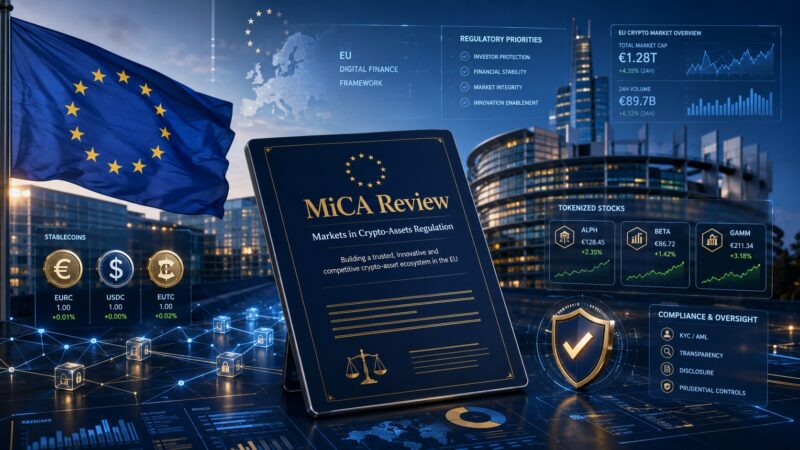
The European Union’s Markets in Crypto-Assets regulation, better known as **MiCA**, was designed to create one of the world’s most comprehensive digital asset frameworks. It brought crypto exchanges, stablecoin issuers, custody providers and other service providers under a unified regulatory system across the EU.
But the market has changed quickly.
Stablecoins are becoming payment infrastructure. Tokenized stocks and real-world assets are moving closer to regulated capital markets. Offshore crypto platforms remain difficult to supervise. DeFi and derivatives continue to sit in areas that regulators are still trying to define.
That is why Europe is now reviewing whether MiCA needs an update. CoinDesk reported that the EU is reviewing whether its landmark crypto regulation needs recalibration for a market reshaped by stablecoins and tokenization.
For investors, the message is clear: European crypto regulation is no longer just about licensing exchanges. It is becoming a larger debate about how digital assets connect to banks, payments, securities markets and global financial stability.
What Is MiCA?
MiCA is the European Union’s main crypto asset regulation.
According to the European Securities and Markets Authority, MiCA establishes uniform EU market rules for crypto assets and covers crypto assets that are not already regulated under existing financial services legislation.
The framework applies to crypto asset service providers, token issuers and stablecoin-related activities. Its goal is to create consistent rules across EU member states instead of leaving crypto regulation fragmented across national systems.
In practice, MiCA affects exchanges, custodians, brokers, token issuers, wallet providers and stablecoin businesses that want to serve EU users.
The regulation is important because Europe is trying to create a single crypto market with clearer licensing standards, stronger consumer protection and better supervision of digital asset firms.
Why Europe Is Reviewing MiCA Now
The timing matters.
MiCA was a major regulatory achievement, but crypto markets have moved faster than legislation. Since the framework was drafted, stablecoins have become larger, tokenization has accelerated, and institutional crypto products have become more closely connected to traditional finance.
CoinDesk reported that Europe’s MiCA framework is now undergoing a review often described as “MiCA 2.0,” through a consultation process expected to close around September. The review could examine whether the original framework is still fit for purpose in a rapidly changing market.
Legal analysis from Skadden also noted that the European Commission launched a consultation on the review of MiCA, giving market participants until the end of August 2026 to submit comments on whether the regulation remains fit for purpose.
This does not mean MiCA has failed. It means regulators are trying to keep the rulebook aligned with a market that is changing quickly.
The July 1 Deadline Is Reshaping the EU Crypto Market
One of the biggest immediate changes is the end of MiCA’s transitional period.
ESMA stated that MiCA’s transitional period officially expired across the EU on July 1, 2026. After that date, any entity providing crypto asset services in the EU without full authorization is operating in breach of EU law and must stop offering those services to EU clients.
This is a major market reset.
For years, many crypto companies operated under different national regimes or transitional arrangements. Now, firms that want to serve EU users need authorization under the MiCA framework.
The Financial Times reported that only a small fraction of crypto groups in the EU held licenses as the new rules came into force, with many companies required to stop operating because they had not secured approval.
For investors, this matters because exchange access, liquidity, custody options and platform availability may change across Europe. Users could see accounts restricted, services withdrawn or assets migrated to licensed providers.
Stablecoins Are at the Center of the Review
Stablecoins are one of the most important reasons Europe is reconsidering parts of its crypto framework.
Stablecoins are no longer only tools for crypto trading. They are increasingly used for settlement, payments, cross-border transfers, DeFi liquidity and tokenized asset markets.
That creates new risks.
Stablecoin issuers may hold reserves in bank deposits, government securities and other low-risk instruments. This connects crypto markets directly to the banking system. Reuters reported that a UniCredit risk executive warned Europe may be less equipped than the U.S. to handle shocks from the intersection of crypto assets and banks, especially because MiCA requires stablecoin issuers to hold reserves in bank deposits or other low-risk assets.
This is a key concern for regulators.
If a major stablecoin faces redemption pressure, the effect may not stay inside crypto. It could affect banks, money markets, payment systems and investor confidence.
That is why Europe’s MiCA review is likely to focus heavily on stablecoin reserves, redemption rights, issuer supervision and systemic risk.
Sanctioned Stablecoins Show the Compliance Problem
Stablecoins also raise questions about sanctions enforcement and cross-border finance.
CoinDesk reported that the sanctioned Russian stablecoin A7A5 claimed it processes billions in activity, while blockchain analytics firms disputed those claims and said the token’s volumes had fallen sharply this year. Analysts argued that sanctions and the collapse of a key Russia-linked exchange reduced A7A5’s momentum.
This example matters because it shows how stablecoins can become part of geopolitical and sanctions debates.
Regulators are not only concerned about consumer protection. They are also watching whether digital assets can be used to move value around restrictions, support sanctioned entities or create parallel payment rails outside normal banking controls.
For Europe, a stronger MiCA review may need to consider not only licensed stablecoins, but also how EU firms interact with offshore tokens, sanctioned addresses and non-EU issuers.
Tokenization Is Making Crypto More Like Capital Markets
Tokenization is another reason MiCA may need updating.
Tokenized assets are digital representations of stocks, bonds, funds, commodities or other real-world assets on blockchain networks. This sector is growing quickly because banks, asset managers and fintech firms are exploring blockchain-based settlement and 24/7 asset transfer.
The challenge is that tokenized securities can sit between crypto law and traditional securities law.
CoinDesk recently reported that Securitize tokenized about $295 million of its own stock on Solana and Avalanche during its NYSE debut, calling it the largest issuer-sponsored tokenized stock at launch.
CoinDesk also reported that Ondo Finance introduced an SEC-aligned tokenized stock model involving BlackRock’s iShares Core S&P 500 ETF and Micron shares, using a structure designed to remain within existing U.S. market rules.
These developments are not Europe-specific, but they show why European regulators are paying attention. If tokenized securities become more common, regulators need to clarify how these products interact with custody, transfer agents, investor eligibility, settlement finality and market abuse rules.
MiCA May Not Fully Cover DeFi and Derivatives
Another issue is that MiCA was not designed to solve every crypto market problem.
Crypto derivatives, offshore leverage and DeFi protocols remain difficult areas for regulators. These markets can affect European users even when the platforms are based outside the EU.
This matters because derivatives can amplify volatility. A sharp move in Bitcoin or Ether can trigger liquidations, forced selling and rapid changes in risk appetite across the entire market.
CoinDesk reported that Bitcoin and Ether traders were not fully buying a recent bounce, with options markets showing caution even as spot prices recovered.
This type of positioning matters for regulators because market structure risk does not come only from spot exchanges. It also comes from derivatives, offshore platforms, stablecoin liquidity and leveraged trading.
If MiCA 2.0 expands the framework, regulators may look more closely at these areas.
Europe Wants a Single Market, But Licensing Is Hard
MiCA’s biggest ambition is to create a single European crypto market.
In theory, a firm licensed in one EU member state can use that authorization to operate across the bloc. This could reduce fragmentation and make Europe more attractive for compliant crypto businesses.
In practice, licensing is difficult.
Firms need governance systems, cybersecurity controls, capital, compliance teams, AML procedures, custody standards and reporting processes. Smaller firms may struggle with these requirements, while larger exchanges and financial institutions may be better positioned.
Euronews reported that MiCA’s full application is forcing a market reset, with many firms facing exit while licensed companies may benefit from consolidation.
For investors, this may lead to a more regulated but less crowded market. The number of available platforms may shrink, but the surviving firms may be more closely supervised.
Why This Matters for Global Crypto Markets
Europe’s MiCA review matters beyond Europe.
The EU often influences global regulation because firms that want to serve European users must adapt to EU rules. If MiCA becomes stricter on stablecoins, custody, tokenization or offshore services, global exchanges and issuers may adjust their business models.
This is especially important at a time when the U.S., U.K. and Asia are also developing crypto rules.
Reuters reported that the U.K. reduced a proposed stablecoin capital requirement in its final crypto rulebook, lowering the requirement from 2% to 1% of the total value issued as part of an effort to create a more proportionate framework.
That shows a competitive policy environment. Europe wants strict supervision, but it also needs to avoid pushing innovation entirely offshore.
This is one of the central questions for MiCA 2.0: how can Europe protect investors and financial stability without making the region less competitive for blockchain innovation?
Market Conditions Add Pressure to the Policy Debate
The MiCA review is happening while crypto markets remain sensitive to liquidity and macro conditions.
CoinDesk reported that Bitcoin whales accumulated more than 270,000 BTC worth about $16.7 billion over two weeks even as U.S. spot Bitcoin ETFs saw record outflows in June. The divergence suggests that large holders were absorbing supply while institutional ETF demand weakened.
CoinDesk also reported that crypto ended a week on firmer footing after weak U.S. jobs data reduced the perceived risk of a Federal Reserve rate hike, helping Bitcoin recover from recent lows.
This matters because regulation does not operate in isolation. If market liquidity is weak, policy headlines can have a larger impact. If investors are already cautious, uncertainty around licensing, stablecoins or tokenization can amplify volatility.
Political Risk Is Also Part of Crypto Regulation
Crypto regulation is increasingly political.
In the United States, debates over crypto rules have been affected by questions around political conflicts of interest. Reuters reported that President Donald Trump disclosed more than $1.4 billion in income from crypto-related ventures in 2025, making digital assets a major source of his reported income.
CoinDesk also reported that Trump said there was “nothing wrong” with his family’s crypto windfall, while critics argued that he was profiting from the sector while his administration shaped crypto rules.
This is relevant to Europe because it shows that crypto regulation is no longer just a technical policy debate. It is also about ethics, public trust, conflicts of interest and whether rules are being written in a way that serves consumers or powerful market participants.
Europe’s MiCA review may not involve the same political dynamics, but the broader lesson is clear: regulators want crypto markets to appear legitimate, transparent and accountable.
What Investors Should Watch Next
Investors should watch several signals as Europe reviews MiCA.
The first signal is the outcome of the European Commission’s consultation. Market participants will be watching whether the review leads to stronger rules for stablecoins, DeFi, derivatives, custody or tokenization.
The second signal is ESMA’s role. CoinDesk reported that ESMA may become a more centralized supervisory body for Europe’s crypto framework.
The third signal is licensing activity. More firms may receive MiCA authorization, while others may leave the EU market.
The fourth signal is stablecoin policy. Reserve rules, redemption rights, issuer supervision and bank exposure will remain major topics.
The fifth signal is tokenization. Regulators need to decide how blockchain-based securities and real-world assets fit into existing capital market rules.
The sixth signal is offshore enforcement. Europe may become stricter toward non-EU platforms serving EU customers without authorization.
Is MiCA 2.0 Bullish or Bearish for Crypto?
A MiCA review can be both bullish and bearish depending on the outcome.
It may be bullish for regulated platforms, institutional adoption and tokenized assets if clearer rules increase trust. Large exchanges, custodians, banks and asset managers may benefit from a more predictable framework.
It may be bearish for unlicensed firms, weak compliance models and offshore platforms that rely on regulatory gaps.
For stablecoins, the impact depends on whether Europe chooses a flexible approach or a stricter model that makes issuance and usage more difficult.
For tokenization, clearer rules could unlock growth. But if requirements become too heavy, innovation may move to other regions.
The key point is that regulation is becoming a market filter. Stronger players may benefit, while weaker or non-compliant firms may disappear from the EU market.
Near-Term Outlook
The near-term outlook depends on how aggressively Europe moves from review to rule changes.
If MiCA 2.0 focuses on targeted improvements, it could strengthen Europe’s position as a regulated crypto market. That would support institutional adoption, especially in custody, stablecoins and tokenized assets.
If the review creates uncertainty or overly restrictive rules, firms may hesitate to expand in Europe until the framework becomes clearer.
For now, investors should treat MiCA as a major structural factor for European crypto markets. It affects platform access, stablecoin availability, tokenization products, compliance costs and institutional participation.
Final Thoughts
Europe’s review of MiCA shows that crypto regulation is entering a more mature stage.
The original MiCA framework created a unified rulebook for crypto assets across the EU. Now regulators are asking whether that rulebook is strong enough for a market shaped by stablecoins, tokenized securities, DeFi, offshore platforms and institutional adoption.
For investors, the key takeaway is that Europe is not stepping back from crypto regulation. It is refining it.
MiCA 2.0 could become one of the most important regulatory developments for global crypto markets in 2026. It may determine which firms can operate in Europe, how stablecoins are supervised, how tokenized assets are treated and how much room remains for innovation.
The crypto market is still driven by price, liquidity and sentiment. But increasingly, it is also driven by regulation.
This article is for market information and educational purposes only. It should not be considered legal, tax or financial advice.
FAQ
What is MiCA?
MiCA, or Markets in Crypto-Assets, is the European Union’s main crypto regulation. It creates common rules for crypto asset service providers, token issuers and stablecoin-related activities across the EU.
Why is Europe reviewing MiCA?
Europe is reviewing MiCA because the crypto market has changed quickly. Stablecoins, tokenization, DeFi, derivatives and offshore activity have created new regulatory challenges.
What is MiCA 2.0?
MiCA 2.0 is an informal term used to describe Europe’s review of the existing MiCA framework. It may lead to updates or adjustments to crypto rules in the EU.
Why are stablecoins important to MiCA?
Stablecoins are important because they connect crypto markets with banks, payments and cross-border settlement. Regulators are focused on reserves, redemptions, systemic risk and compliance.
How does tokenization affect crypto regulation?
Tokenization brings stocks, bonds, funds and other real-world assets onto blockchain networks. This creates new questions about custody, securities law, settlement and investor protection.
Could MiCA force crypto firms out of Europe?
Yes. Firms that cannot meet MiCA authorization standards may need to stop serving EU customers. Licensed firms may benefit as the market consolidates.
Is MiCA good or bad for crypto?
MiCA can be positive for regulated firms and institutional adoption, but it may be challenging for smaller platforms, offshore exchanges and projects with weak compliance systems.
Internal Link Suggestions
- US Senate Pushes for July Passage of the CLARITY Act
- Are Vietnamese Investors Required to Trade Through Licensed Domestic Crypto Exchanges?
- Open USD Stablecoin Explained: Why Big Tech and Wall Street Are Entering Crypto Payments
- What Are Tokenized Assets and Why Are They Important?
- Stablecoin Regulation Explained: Why Digital Dollars Are Reshaping Crypto Markets
Emma Rodriguez leads the educational content team at CoinPulseNews. She creates beginner-friendly guides that help new crypto users navigate the market safely.
The author may hold BTC. Content is educational only.