
Bandot (BANDO/BDT) Draws Attention, But Market Data Shows Extreme Low-Liquidity Risk
Bandot is appearing in crypto searches, but verified data shows ticker confusion, tiny trading volume and weak liquidity. Here’s what traders should check first.

Key Takeaways
- Bandot appears across crypto trackers under both BDT and BANDO, creating ticker confusion for traders.
- CoinDesk lists Bandot under the BANDO ticker and says the BANDO label was adopted because BDT was already associated with another asset.
- CoinMarketCap and Binance list Bandot Protocol as BDT, but both show extremely low trading volume and unavailable or zero circulating-supply data.
- Current verified market data suggests Bandot is a very low-liquidity micro-cap token, not a high-conviction market trend.
- Search results do not show a strong, recent, widely verified news catalyst for Bandot.
- Bandot Protocol has been described as a Polkadot-related DeFi lending project, but public data on team, backers and current adoption appears limited.
- Traders should verify contract addresses, liquidity, exchange support, holder distribution and official announcements before reacting to Bandot-related social posts.
Bandot is beginning to appear in crypto searches, but the available market data suggests traders should be careful before treating it as a strong new altcoin narrative.
The first issue is basic but important: **Bandot appears under more than one ticker**.
Some trackers refer to **Bandot Protocol as BDT**, while CoinDesk lists **Bandot as BANDO**. CoinDesk explains that BANDO is used because BDT was already associated with another asset with larger market presence and higher trading volume, so the alternative ticker was adopted to avoid marketplace confusion.
That ticker confusion matters because low-liquidity assets can become especially risky when traders are not sure which token, market or contract address they are actually viewing.
What Is Bandot?
Bandot is generally associated with **Bandot Protocol**, a DeFi-focused crypto project.
HTX describes Bandot Protocol as a stablecoin unsecured lending system built around Polkadot infrastructure, aiming to support lending across blockchain networks. However, the same HTX overview also notes that details about the creator or founding team are unspecified and that information about investors or backers has not been disclosed.
This makes Bandot a very different type of asset from larger, more transparent DeFi protocols.
The concept may be related to stablecoin lending and cross-chain DeFi, but the publicly verifiable data available today is limited. That means traders should avoid assuming that Bandot has active ecosystem traction unless they can confirm recent product updates, user activity, liquidity and development progress.
Bandot’s Market Data Looks Extremely Thin
The strongest verified signal is liquidity — and Bandot’s liquidity looks very weak.
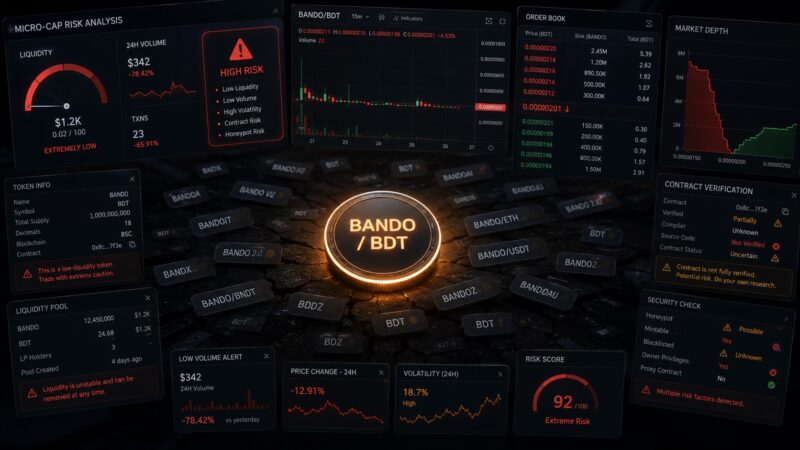
CoinMarketCap lists Bandot Protocol under the ticker **BDT** with a live price around **$0.000010**, 24-hour trading volume near **$18**, no available live market cap, and unavailable circulating and maximum supply data.
Binance’s price directory shows a similar picture for Bandot Protocol, listing BDT around **$0.0000095**, with **$0** market cap, about **$18** in 24-hour volume, and a circulating supply of **0**.
CoinDesk’s BANDO page also shows very small numbers, listing Bandot at about **$0.000009540**, with a market cap around **$19,080**, 24-hour volume near **$17**, and total supply of **2 billion**.
These figures all point to the same conclusion: **Bandot is an extremely low-liquidity asset based on current tracker data.**
Why Low Liquidity Is a Major Risk
Low liquidity changes everything.
A token with only a few dollars or tens of dollars in reported daily volume cannot be analyzed like a normal altcoin. Price movements may not reflect real market demand. Spreads can be wide, small trades can move the chart, and exiting a position may be difficult.
This is especially important for Bandot because multiple trackers show either unavailable market-cap data, zero circulating supply, or extremely small trading activity.
For traders, this means Bandot should be treated as a **high-risk micro-cap token**, not as a confirmed breakout project.
Even if the token price moves sharply, the move may not be meaningful if it happens on tiny volume.
No Strong Recent News Catalyst Was Clearly Verified
The keyword “Bandot” does not currently appear to have a strong, widely verified news catalyst from major crypto media.
Search results mainly return price pages, exchange directory pages, old project descriptions and market trackers. CryptoRank’s Bandot Protocol news page also appears to show general crypto news content rather than a clearly relevant, recent Bandot-specific catalyst.
This is important for content accuracy.
If Bandot is being discussed on social media, that may reflect micro-cap attention or speculative searching. But without a verifiable catalyst, it would be misleading to present Bandot as a major trending crypto story.
The safer framing is: **Bandot is a low-liquidity token appearing in search interest, but current public data does not confirm a major new development.**
The BDT vs BANDO Issue Can Confuse Traders
The ticker issue deserves special attention.
CoinMarketCap and Binance refer to Bandot Protocol as **BDT**. CoinDesk lists Bandot as **BANDO** and explains that the BANDO ticker was adopted because BDT already had stronger pre-existing association with another asset.
This can create practical trading risk.
A user searching for “Bandot” may encounter different tickers, different tracker pages, different market-cap estimates and potentially different contract references. For a low-liquidity token, that confusion can increase the chance of buying the wrong asset, using the wrong contract, or relying on inaccurate price data.
Before trading or writing a strong market claim about Bandot, traders should verify:
contract address;
official website;
active trading venues;
liquidity depth;
holder distribution;
latest official announcements;
whether BDT and BANDO refer to the same tracked asset in the relevant venue.
Official Links Exist, But Activity Still Needs Verification
Bitget’s Bandot Protocol page lists official resources including the Bandot website, whitepaper, X account and GitHub.
That is useful, but it does not automatically prove current adoption or active development.
For a micro-cap token, official links should be treated as a starting point, not final proof. Traders should still check whether the website is active, whether GitHub has recent commits, whether smart contracts are verified, whether social channels are maintained, and whether the project has recent product or ecosystem updates.
A project can have official links and still have weak liquidity, limited adoption or inactive development.
Why Bandot Should Not Be Treated Like a Normal Altcoin
Bandot’s current data profile is very different from a liquid altcoin.
A liquid altcoin usually has clear circulating supply, active trading volume, multiple exchange markets, visible ecosystem data and reliable market-cap tracking. Bandot’s current data does not show that level of maturity.
Instead, the available data points to:
ticker ambiguity;
very low reported trading volume;
unclear circulating supply;
limited recent news coverage;
small or unavailable market capitalization;
weak public confirmation of current adoption.
This does not mean Bandot cannot move. In fact, micro-cap tokens can move violently. But it does mean price action can be unreliable and highly risky.
What Traders Should Watch Next
The first thing traders should watch is whether Bandot gains real liquidity.
If reported trading volume remains near extremely low levels, price movement should be treated with skepticism. A meaningful improvement would require sustained volume across reputable venues, deeper order books and clearer market-cap data.
The second thing to watch is official project activity. Any new roadmap, exchange listing, product launch, liquidity program or protocol update should be confirmed from official Bandot channels and cross-checked against independent sources.
The third thing to watch is ticker consistency. If BDT and BANDO continue to appear separately across trackers, traders need to be extra careful with contract verification.
The fourth thing to watch is whether Bandot receives coverage from credible crypto media. Without independent coverage, social posts alone should not be treated as confirmed market catalysts.
The fifth thing to watch is liquidity migration. For a token this small, even modest liquidity changes can reshape price discovery.
Near-Term Outlook
The near-term outlook for Bandot is highly speculative.
The token may attract attention because micro-cap assets can become attractive to risk-seeking traders during altcoin rotations. However, verified data currently shows extremely low liquidity and unclear supply metrics.
That makes Bandot unsuitable for aggressive claims such as “breakout candidate,” “strong accumulation,” or “major trend” unless new evidence appears.
The most reasonable interpretation is that Bandot is a **watchlist token**, not a confirmed market narrative.
If liquidity improves, official updates resume and market data becomes clearer, Bandot could become more interesting. If volume remains near current levels and no credible catalyst emerges, the token should be treated as a high-risk, low-information asset.
Final Thoughts
Bandot is a good example of why crypto keyword research needs verification.
At first glance, a token appearing in searches may look like a new trend. But the verified data tells a more cautious story.
CoinMarketCap and Binance show Bandot Protocol under BDT with extremely low volume and unclear supply data. CoinDesk lists Bandot under BANDO and highlights the ticker confusion. HTX describes the project as a Polkadot-related DeFi lending protocol, but also notes that public information about the team and backers is limited.
For readers and traders, the key takeaway is simple: **Bandot should be approached with caution until stronger data appears.**
Before reacting to social posts or price-tracker movements, verify the contract, liquidity, official announcements and current trading venues. In low-liquidity micro-cap tokens, the biggest risk is not missing the move — it is entering a market where reliable exit liquidity may not exist.
This article is for market information and educational purposes only. It should not be considered financial advice.
Internal Link Suggestions
- Trump Memecoin Losses and Vector (VSG) Hype Show the Risk of Retail-Driven Crypto Narratives
- Plasma (XPL) Gains Attention as Plasma One Card Fuels Stablecoin Payment Narrative
- July Token Unlocks Put PUMP in Focus as $776M Supply Wave Tests Crypto Liquidity
- Solana, Sui and Aptos: The Fierce Battle of High-Performance Layer-1 Blockchains
- XRP Divergence Signal: Binance Scarcity Index Hits Two-Year High as Price Stalls Near $1.10
Sarah Mitchell reports on decentralized finance, NFTs, and the evolving Web3 ecosystem. She specializes in making complex DeFi protocols understandable for newcomers.
The author may hold various DeFi tokens. This is not financial advice.