
Bittensor (TAO) in 2026: Root Reborn and the Next Test for Decentralized AI
Bittensor’s TAO token is back in focus as Root Reborn, post-halving scarcity, AI subnet growth and institutional access reshape its decentralized AI thesis.
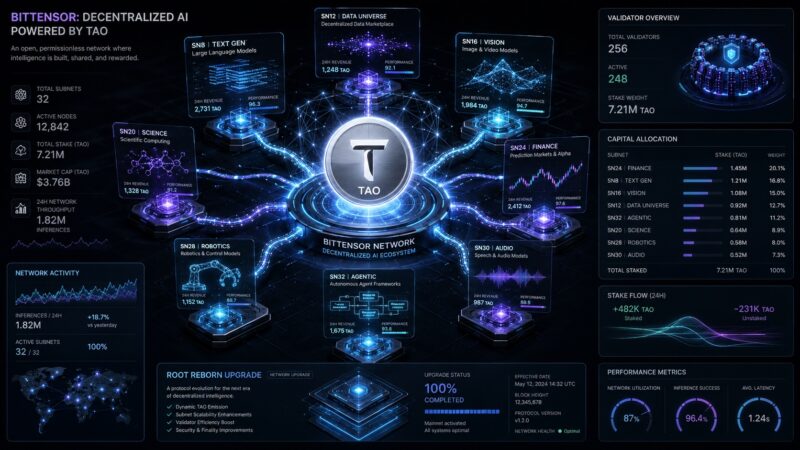
Key Takeaways
- Bittensor is building a decentralized marketplace where independent subnets produce AI models, data, compute and other digital commodities.
- TAO is trading near the $205–$213 range, with market capitalization estimates above $2 billion.
- Bittensor completed its first halving in December 2025, reducing network issuance from 1 TAO to 0.5 TAO per block.
- The proposed Root Reborn upgrade would turn validators into active allocators across Bittensor subnets.
- Root Reborn is not yet a fully deployed protocol change and has received criticism over conflicts of interest and risk to stakers.
- Bittensor’s investment case depends on whether subnets generate useful AI products and sustainable revenue rather than only token speculation.
- Institutional access is expanding through regulated products, exchange availability and specialist investment funds.
- Concentration, subnet-token liquidity, governance complexity and competition from centralized AI remain major risks.
Bittensor is returning to the center of the crypto AI narrative as investors evaluate whether decentralized artificial intelligence can develop into a sustainable digital economy.
Unlike many AI-linked tokens that mainly rely on branding, Bittensor is designed as a network of independent markets called **subnets**. Each subnet can reward participants for producing a specific digital commodity, including AI inference, model training, data, storage, computing resources, financial predictions and other specialized services.
Its native token, TAO, coordinates incentives across this system.
The latest attention is being driven by several developments: Bittensor’s post-halving supply structure, expanding subnet economy, growing exchange access and a controversial proposal called **Root Reborn** that could significantly change how validators allocate staking rewards.
The central question is whether these upgrades can turn Bittensor into genuine decentralized AI infrastructure—or whether increasing financial complexity will make the network more speculative and harder to evaluate.
What Is Bittensor?
Bittensor is an open-source protocol designed to create decentralized markets for digital intelligence and other computational resources.
The network consists of separate subnets. Within each subnet, miners produce a service or digital commodity, validators evaluate their performance, subnet creators design the incentive system and TAO holders can delegate stake to validators. TAO emissions are distributed according to the value the protocol assigns to these contributions.
This model differs from a conventional AI company.
A centralized AI provider owns its models, computing infrastructure and data pipelines. Bittensor attempts to create open markets where independent contributors compete to deliver useful outputs and receive token-based rewards.
The network can therefore be viewed less as one AI model and more as infrastructure for launching multiple competitive digital markets.
TAO Market Data Shows Renewed Activity
TAO is currently trading around **$205**, according to real-time crypto market data. Other trackers have recently displayed prices closer to $213 because prices and reporting timestamps vary between platforms.
CoinMarketCap recently estimated Bittensor’s market capitalization at approximately **$2.37 billion**, with more than $400 million in 24-hour trading volume. It ranked TAO among the larger crypto assets by market capitalization.
CoinGecko showed a market capitalization slightly above $2 billion and reported a significant increase in daily trading volume, indicating renewed market activity around the token.
These figures show that TAO has considerably deeper liquidity than most AI-related tokens. However, it remains highly volatile and is still trading more than 70% below its historical peak, according to CoinGecko data.
Bittensor’s First Halving Changed TAO Issuance
One of the most important changes to TAO’s tokenomics occurred in December 2025.
Bittensor’s first halving took place on December 15, 2025, after the circulating supply reached 10.5 million TAO. The event reduced network issuance from **1 TAO to 0.5 TAO per block**.
TAO has a maximum supply of 21 million tokens. However, Bittensor’s halving schedule is based on total issuance milestones rather than a fixed block interval. Token recycling and registration mechanics can therefore influence the timing of future halvings.
As of July 10, 2026, TaoStats showed approximately **11.1 million TAO** in circulation, equivalent to around 52.9% of maximum supply.
The halving reduced the amount of new TAO entering the market, which can lower structural sell pressure if demand remains stable. But lower issuance does not automatically increase price. TAO still needs demand from network users, stakers, subnet participants and investors.
Dynamic TAO Made Subnets Investable
An earlier major change was the introduction of **Dynamic TAO**, commonly known as dTAO.
Under the system, individual subnets have their own alpha tokens and market-based pricing. This allows investors and participants to allocate capital toward specific subnets rather than gaining exposure only through the main TAO token.
Grayscale Research described the February 2025 dTAO launch as the development that made individual Bittensor subnets investable for the first time. It also reported that the proportion of circulating TAO allocated to subnets increased rapidly following the upgrade.
This created a more dynamic ecosystem, but it also introduced additional complexity.
Investors must now evaluate not only TAO but also the liquidity, incentive structure, validators, products and token economics of individual subnets.
The network increasingly resembles a decentralized marketplace of early-stage AI ventures rather than a single blockchain token.
What Is the Root Reborn Proposal?
Root Reborn is one of the most important current developments within Bittensor.
The proposal would change how rewards from Bittensor’s root layer are managed. Instead of automatically selling subnet alpha tokens for TAO to pay stakers, validators would be able to reinvest rewards into selected subnet tokens. This would effectively turn validators into active portfolio allocators across the Bittensor ecosystem.
Under the proposed structure, a validator could construct a basket of subnet exposure based on its assessment of performance and future potential. TAO stakers would delegate to validators whose allocation strategies they trust.
Supporters believe this could reduce automatic sell pressure on subnet tokens, reward stronger projects and encourage validators to conduct deeper research into the ecosystem.
It may also create compounding subnet portfolios, with validators reinvesting rewards rather than continuously converting them back into TAO.
Root Reborn Is Not Yet a Confirmed Live Upgrade
Root Reborn should not be described as a completed network upgrade.
The proposal has been presented for review, but its code and final implementation have not been fully finalized or deployed. CoinDesk characterized it as a proposed restructuring of how Bittensor validators and staking rewards operate.
This distinction is important because crypto markets frequently price proposed upgrades as though they have already been implemented.
Root Reborn remains subject to technical review, testing, community debate and potential modification. Its final design may differ from current descriptions.
Investors should therefore treat it as a potential catalyst rather than an established feature of Bittensor’s mainnet.
The Proposal Could Reduce Mechanical Selling
The bullish argument for Root Reborn is based partly on market structure.
Under existing mechanics, subnet rewards may be converted into TAO, creating recurring selling pressure on subnet alpha tokens. Root Reborn would allow validators to retain and reinvest that exposure instead.
If successful, this could:
- reduce automatic subnet-token selling;
- direct more capital toward productive subnets;
- reward validators with stronger allocation strategies;
- create long-term alignment between validators and subnet teams;
- give TAO stakers more differentiated investment choices.
The proposal may also strengthen the connection between subnet performance and capital allocation. High-quality subnets could attract more validator exposure, while weaker subnets might lose funding.
However, that same mechanism introduces new governance and concentration risks.
Validators Could Become Powerful Capital Allocators
Root Reborn would give validators greater influence over which subnets receive capital.
This is why commentators have compared them with fund managers. Stakers would no longer be choosing validators primarily for technical performance or basic reward delivery. They would also be choosing investment strategies.
That model could improve capital efficiency if validators make informed and independent decisions.
But it creates difficult questions:
Can validators fairly evaluate subnets in which they have financial interests?
Could large validators direct capital toward affiliated projects?
How transparent will portfolio allocations be?
Could popular validators gain excessive influence over subnet valuations?
How should stakers evaluate risk-adjusted performance?
These questions show that Root Reborn is not simply a tokenomics adjustment. It could reshape Bittensor’s economic governance.
Yuma Has Warned About Root Reborn Risks
Not every major Bittensor participant supports the proposal in its current form.
Yuma, a prominent company building and investing in the Bittensor ecosystem, warned that Root Reborn could introduce conflicts of interest, regulatory concerns and additional risks for TAO stakers. It called for more extensive testing, formal risk analysis and a clearer implementation roadmap.
The concern is that validators could allocate rewards toward subnets they own, support or have undisclosed relationships with.
If that happened, subnet valuations might become influenced by validator relationships rather than product quality or genuine demand.
The criticism does not mean Root Reborn will fail. It indicates that the proposal requires stronger safeguards before it can operate as a credible decentralized capital-allocation system.
Bittensor’s Real Value Depends on Subnet Products
Bittensor’s strongest investment argument is not the price of TAO. It is the possibility that subnets can produce commercially useful AI and digital services.
Official documentation says subnets can specialize in AI inference, training, storage, compute, data, financial prediction, protein folding and other digital commodities.
If these services become competitive with centralized alternatives, Bittensor could develop into a decentralized marketplace for AI infrastructure.
The most important metrics are therefore not only token prices. Investors should also examine:
“`text
Actual subnet users
Revenue generated outside token incentives
Quality of AI outputs
Cost compared with centralized providers
Developer and miner participation
Customer retention
Validator concentration
Subnet liquidity
Dependence on emissions
“`
A subnet that generates most of its activity from token incentives may struggle when rewards decline. A subnet with paying customers and useful products has a stronger long-term foundation.
Institutional Access Is Expanding
Institutional interest in Bittensor has gradually expanded.
Grayscale operates a Bittensor Trust designed to provide investors with exposure to TAO through a traditional investment vehicle. However, Grayscale warns that the trust’s shares can trade at substantial premiums or discounts to the value of its underlying assets and that the product has not always met its tracking objective.
TAO is also currently available through major exchanges, including Coinbase, OKX and Kraken, improving access for retail and professional market participants.
Separately, a specialist hedge fund focused on Bittensor reportedly began seeking $20 million in new capital in June 2026. Its marketing materials described subnet opportunities as early-stage and structurally illiquid.
These developments suggest growing professional interest, but they should not be interpreted as proof that TAO or subnet tokens are low-risk investments.
Subnet Liquidity Is a Serious Risk
Individual subnet tokens can be far less liquid than TAO.
Research examining 128 Bittensor subnets found that smaller subnet tokens displayed a substantial size-related return premium. However, the study also concluded that transaction costs and slippage could eliminate returns for larger portfolios. At approximately $100,000 in capital, estimated trading costs exceeded the modeled gross returns.
This has important implications.
Subnet prices may look attractive on paper, but large investors may be unable to enter or exit without moving the market. Reported valuations can therefore overstate the amount of capital that could realistically be withdrawn.
Root Reborn could increase demand for selected subnet tokens, but it could also amplify volatility if large validator allocations enter illiquid markets.
Concentration Remains a Structural Concern
Bittensor’s decentralized AI model still faces questions about stake and reward concentration.
An academic analysis of Bittensor found considerable concentration in stake and rewards across the network. The researchers argued that compensation was strongly influenced by stake and could become misaligned with the actual quality of subnet output.
This is a critical issue because Bittensor’s thesis depends on rewarding useful intelligence rather than merely rewarding capital.
If large stakeholders have disproportionate control over validators, emissions or subnet rankings, the network could reproduce the same concentration it is designed to replace.
Governance upgrades such as Root Reborn and conviction-based locking may improve long-term alignment, but they could also consolidate influence if poorly implemented.
Competition From Centralized AI Is Intense
Bittensor is competing against some of the world’s largest technology companies.
Centralized AI providers have access to enormous computing budgets, proprietary datasets, established distribution and corporate customers. They can improve products quickly without coordinating token holders, validators and subnet markets.
Bittensor’s advantage is openness.
It can allow independent teams to compete, experiment and receive market-based rewards without requiring permission from a centralized platform.
However, decentralization must produce a measurable benefit. Customers may not care whether an AI service is decentralized if it is slower, more expensive or less reliable than centralized alternatives.
The decisive question is whether Bittensor can produce services that are both decentralized and commercially competitive.
The Bullish Case for TAO
The bullish case for TAO is based on five main factors.
First, Bittensor occupies one of the clearest intersections between blockchain and artificial intelligence.
Second, its subnet architecture allows multiple specialized AI and data markets to develop under one economic system.
Third, the December 2025 halving reduced TAO issuance to 0.5 TAO per block, limiting new supply growth.
Fourth, Root Reborn could reduce mechanical selling and create more active capital allocation across productive subnets if implemented safely.
Fifth, exchange access, Grayscale products and specialist investment funds are expanding the ways investors can gain exposure to the ecosystem.
If subnet revenue and real-world AI usage grow while TAO issuance remains constrained, the token could benefit from stronger structural demand.
The Bearish Case for TAO
The bearish case is centered on execution and financial complexity.
Many subnets remain early-stage and may depend heavily on emissions rather than sustainable customer revenue.
Subnet tokens can also be illiquid, making valuations vulnerable to speculation and severe slippage.
Root Reborn could introduce conflicts of interest by giving validators more power to direct capital. The proposal has not yet been fully implemented and still requires additional testing and risk controls.
Stake and reward concentration remain concerns, while centralized AI firms continue to have significant advantages in capital, data and distribution.
Finally, TAO remains strongly connected to the broader crypto AI narrative. If investors rotate away from AI tokens or broader risk assets weaken, price may decline even if Bittensor continues developing technically.
What Investors Should Watch Next
The first signal is the progress of Root Reborn. Investors should watch whether the proposal receives formal approval, how conflicts of interest are addressed and whether its final code is independently tested.
The second signal is subnet revenue. Sustainable external revenue would be more valuable than activity funded mainly by TAO emissions.
The third signal is staking concentration. A more distributed validator and staking structure would strengthen the decentralized AI thesis.
The fourth signal is subnet liquidity. Expanding liquidity would make subnet valuations more credible and reduce slippage risk.
The fifth signal is institutional access. New exchange listings and regulated investment vehicles can increase demand, but they may also create short-term speculative volatility.
The sixth signal is AI product quality. Bittensor ultimately needs subnet products that compete with centralized AI systems on cost, accuracy or specialized capability.
The seventh signal is TAO’s market structure. Traders should watch whether TAO can sustain volume and form higher lows after its decline from historical highs.
Near-Term Outlook
Bittensor’s near-term outlook is constructive but highly speculative.
TAO is benefiting from renewed trading activity, expanding market access and continuing interest in decentralized AI. Its first halving has also reduced the rate of new supply entering the market.
However, TAO is still substantially below its historical high, and the network’s next major economic upgrade remains under debate.
Root Reborn could become a meaningful catalyst if it improves capital allocation while protecting stakers from conflicts and excessive validator influence. If implementation is rushed or poorly governed, it could instead increase complexity and systemic risk.
In the short term, TAO’s price will likely remain sensitive to the broader AI token market, Bitcoin liquidity and progress on Bittensor protocol changes.
In the longer term, subnet revenue and actual AI utility will matter more than narrative momentum.
Final Thoughts
Bittensor is one of the most ambitious projects in the crypto AI sector.
Rather than attaching an AI label to a conventional token, it is attempting to build decentralized markets for intelligence, data, compute and other digital commodities.
TAO’s post-halving supply, growing subnet economy and improving institutional access provide a credible foundation for further growth. But the network is also becoming increasingly complex.
Root Reborn represents both the opportunity and the risk.
It could transform validators into intelligent capital allocators, reduce automatic selling and direct resources toward productive subnets. It could also create conflicts of interest, increase concentration and expose stakers to strategies they do not fully understand.
For Bittensor to justify a durable valuation, its subnets must produce useful services, attract paying customers and reduce their dependence on token incentives.
The key question is no longer whether decentralized AI is an exciting narrative.
It is whether Bittensor can turn that narrative into a functioning economy.
This article is for market information and educational purposes only. It should not be considered financial advice.
Internal Link Suggestions
- AI and Blockchain in 2026: Hype, Real Utility or the Next Web3 Narrative?
- Solana, Sui and Aptos: The Fierce Battle of High-Performance Layer-1 Blockchains
- July Token Unlocks Put PUMP in Focus as $776M Supply Wave Tests Crypto Liquidity
- Bitcoin Price Faces Liquidity Shock as BTC Battles Key Technical Resistance
- Crypto Macro Outlook 2026: Liquidity, ETF Flows and Bitcoin’s Cycle Risk