
Why Is Zcash (ZEC) Surging? Ironwood Upgrade and Privacy Demand Drive the Rally
Zcash is rallying as traders anticipate the Ironwood upgrade, renewed privacy demand and rising derivatives activity. Can ZEC sustain its latest breakout?

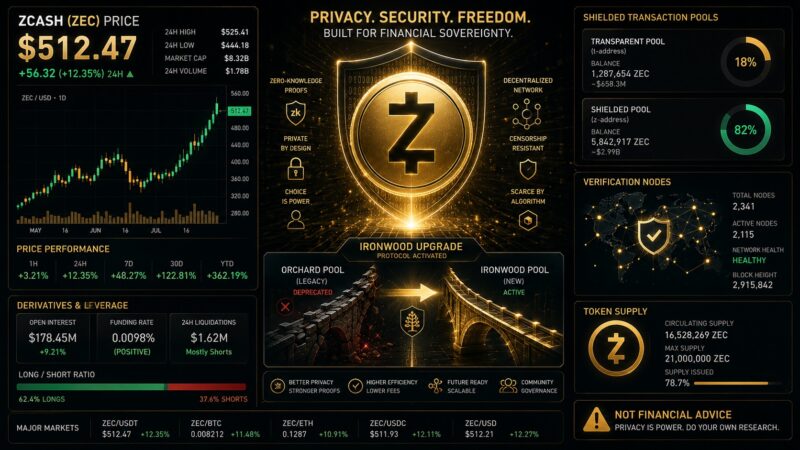
Key Takeaways
- Zcash recently recorded another strong rally as traders positioned ahead of the proposed Ironwood network upgrade.
- The latest move has been supported by rising social attention, renewed demand for privacy-focused assets and increasing derivatives exposure.
- Ironwood is intended to replace the vulnerable Orchard shielded pool and make the integrity of Zcash’s circulating supply easier to verify.
- The upgrade is targeted for late July 2026, but its final timing remains dependent on testing and ecosystem coordination.
- ZEC’s rebound follows a severe June sell-off triggered by disclosure of a critical Orchard vulnerability.
- Rising futures open interest shows that new speculative capital is entering the market, but it also increases liquidation risk.
- ZEC needs sustained spot demand and a successful network upgrade to prevent the rally from becoming another leverage-driven reversal.
Zcash is once again emerging as one of the strongest and most volatile altcoins in the crypto market.
ZEC recently surged by more than 10% during a 24-hour period and temporarily reclaimed the psychologically important $500 region. Third-party social analytics cited by crypto market reports showed a sharp increase in discussion around Zcash, including approximately 28,600 mentions and overwhelmingly bullish tracked sentiment during the move. These figures should be treated as social-platform estimates rather than independently audited network data, but they show that retail attention has returned quickly.
The rally is not being driven by one isolated catalyst.
Traders are positioning around the planned **Ironwood network upgrade**, renewed interest in financial privacy and a sharp increase in leveraged derivatives exposure. ZEC is also recovering from the severe market shock caused by the disclosure of a critical vulnerability in its Orchard shielded pool in June.
This combination has created a highly unusual setup: Zcash is simultaneously trading as a privacy narrative, a protocol-recovery story and a leveraged momentum asset.
The central question is whether ZEC’s latest rally represents a sustainable repricing of Zcash’s technology or another speculative move that could unwind if the upgrade is delayed or market leverage becomes excessive.
What Is Driving the Latest ZEC Price Surge?
The strongest immediate catalyst is anticipation of the Ironwood upgrade.
Zcash developers are working toward a late-July network upgrade designed to create a new shielded pool, stop new value from entering the vulnerable Orchard pool and allow the network’s total circulating supply to be verified more transparently. The official community discussion describes Ironwood as the next stage in hardening the Zcash protocol, while emphasizing that activation timing still depends on testing, code review and coordination among wallets, exchanges, miners and node operators.
A second catalyst is renewed demand for privacy-focused crypto assets.
Zcash uses zero-knowledge cryptography to let users make shielded transactions in which addresses and transaction amounts can remain private. The project describes Zcash as encrypted electronic cash and reports that more than four million ZEC are currently held in shielded form.
A third catalyst is speculation.
CoinGlass data showed ZEC futures open interest rising sharply during the latest move, with tracked open positions approaching or exceeding $900 million depending on the observation time. Rising open interest indicates that additional capital is entering derivatives markets, but it does not reveal whether that capital is predominantly bullish, bearish or hedged.
Together, these forces have created strong price momentum—but also significant liquidation risk.
Ironwood Is the Main Fundamental Catalyst
Ironwood is intended to address the uncertainty created by the Orchard vulnerability.
The proposed upgrade would introduce a new privacy pool using repaired protocol logic. It would also prevent new coins from being created inside the previous Orchard pool and provide a mechanism through which network participants can verify that Zcash’s aggregate supply has not exceeded the permitted amount.
That supply-verification function is critical.
Privacy protocols intentionally hide transaction-level information. While this protects users, it can make certain supply-integrity questions more difficult to verify than on fully transparent blockchains. The Orchard vulnerability therefore created a serious confidence problem even though developers said they had found no evidence that the flaw had actually been exploited.
Ironwood attempts to solve that problem without abandoning Zcash’s privacy model.
If implemented successfully, the upgrade could restore trust by allowing users to preserve shielded transactions while also providing greater confidence that no unauthorized ZEC was created.
The Upgrade Date Should Not Be Treated as Final
Some secondary reports have cited potential activation dates around July 21 or July 28.
However, the official development discussion uses the more cautious target of **late July 2026** and specifically notes that timing depends on testing, review and coordination across the ecosystem. Developers are simultaneously preparing the Ironwood upgrade and migrating infrastructure away from the older `zcashd` implementation toward a newer stack involving Zebra, Zaino and Zallet.
That distinction matters for traders.
Crypto markets frequently price proposed upgrade dates as guaranteed events. If technical testing, exchange preparation or wallet compatibility takes longer than expected, the upgrade could be delayed.
A delay would not necessarily invalidate the long-term Zcash thesis, but it could weaken short-term momentum because part of the current rally is based on expectations surrounding the upgrade.
ZEC Is Recovering From a Major Security Shock
The latest rally follows one of Zcash’s most severe market shocks in years.
In early June, Shielded Labs disclosed a critical flaw affecting the Orchard pool. The vulnerability theoretically threatened a core monetary guarantee because it could have allowed counterfeit ZEC to be created without immediate detection.
ZEC fell as much as approximately 50% during the initial market reaction, while bearish futures positions reached record levels and roughly $118 million in leveraged positions were liquidated.
Developers subsequently said the flaw had been patched and that they had not found evidence of exploitation. Nevertheless, the incident damaged confidence because privacy systems depend heavily on the soundness of their cryptographic and accounting assumptions.
ZEC then rebounded by approximately 45% from its post-disclosure low as developers presented the Ironwood recovery proposal.
The current rally should therefore be understood partly as a restoration-of-confidence trade.
Why the Orchard Vulnerability Was So Serious
The Orchard pool is part of Zcash’s shielded transaction system.
Shielded transactions use zero-knowledge proofs to validate that a transaction follows network rules without revealing sensitive information such as the participants or transferred amount. Zcash was one of the first major blockchain networks to implement this type of cryptography at scale.
A flaw affecting the supply logic of a shielded pool is particularly serious because users cannot simply inspect every private transaction through a conventional public block explorer.
The Ironwood design is intended to introduce a controlled migration process and a new pool whose supply can be reconciled against the network’s broader monetary base. That would make it possible to verify aggregate supply without publicly exposing private user activity.
This is why the market is treating Ironwood as more than an ordinary software update.
It is a test of whether Zcash can recover from a fundamental trust event while preserving its core privacy features.
Privacy Is Returning as a Major Crypto Narrative
ZEC’s rally is also part of a broader repricing of financial privacy.
Bitcoin transactions are pseudonymous rather than fully private. Wallet addresses and transfer amounts remain visible on the public blockchain, and blockchain analytics firms can often connect addresses with real-world entities.
Zcash gives users the option of moving funds through shielded addresses using zero-knowledge proofs. This allows transaction information to remain confidential while still permitting the network to verify that the transfer is valid.
Interest in this technology has increased as governments, institutions and analytics companies expand their ability to monitor public blockchain activity.
The Wall Street Journal reported that early Bitcoin supporters and prominent crypto investors had begun revisiting Zcash because of its stronger privacy protections. The report connected ZEC’s resurgence with concerns over financial surveillance and demand for confidential digital payments.
Business Insider similarly reported that the privacy narrative had helped ZEC significantly outperform Bitcoin over a recent one-month period, while institutional investors and long-time crypto participants increased their exposure to the asset.
AI and Quantum Computing Are Strengthening the Privacy Narrative
The rise of artificial intelligence is adding another dimension to the privacy debate.
AI systems can process enormous volumes of personal, financial and blockchain data. As these systems become more sophisticated, investors are becoming more aware that transparent financial records can be analyzed, categorized and connected with other identity information.
Quantum computing is a longer-term concern. sufficiently powerful quantum computers could eventually threaten some of the cryptographic assumptions used by existing blockchain networks.
Zcash developers and researchers have been discussing roadmaps for stronger scalability and quantum-resistant privacy infrastructure. Recent industry coverage described work intended to combine zero-knowledge technology with verifiable computation while preparing the network for future cryptographic risks.
These developments do not mean Zcash is already completely quantum-resistant. Instead, they contribute to the broader perception that privacy-oriented networks may become more valuable as data analysis and surveillance technology improve.
Social Momentum Is Amplifying the Rally
ZEC’s latest move has also been amplified by social media.
Market reports based on LunarCrush-style social analytics said Zcash reached a high alternative-ranking position while generating tens of thousands of mentions and close to one million recorded engagements. Approximately 84% of tracked sentiment was classified as bullish.
These figures help explain the speed of the move, but they should not be interpreted as fundamental adoption data.
Social momentum can attract new buyers, increase exchange volume and push traders into leveraged positions. It can also reverse quickly once engagement declines.
The relationship between social attention and crypto prices is often reflexive:
“`text
Price rises
Social discussion increases
New traders enter the market
Volume and leverage increase
Price moves become larger
Attention increases again
“`
This cycle can support powerful rallies, but it can also create unstable market structures if demand is based primarily on momentum rather than sustained spot accumulation.
Derivatives Activity Is Becoming a Major Risk
Rising futures open interest is one of the clearest warning signals around ZEC.
CoinGlass data showed open interest near the $900 million area during the latest rally, with some observations indicating double-digit growth over 24 hours. Futures trading volume was also substantially larger than reported spot volume.
This suggests that leveraged traders are playing a significant role in price discovery.
If price rises while open interest increases, it usually means traders are opening new positions rather than merely closing existing ones. That can support momentum, but it also means more capital is exposed to liquidations.
Positive funding rates indicate that long traders are paying short traders to maintain positions. When funding and open interest rise together, the market can become vulnerable to a long squeeze if price suddenly falls.
ZEC already demonstrated this risk during the June security shock, when forced liquidations accelerated its decline.
Is the Current Move a Short Squeeze?
Part of the rally may reflect short covering.
After the Orchard disclosure, bearish bets increased rapidly as traders expected the security crisis to continue pressuring ZEC. When developers introduced a recovery proposal and the token stabilized, some short sellers were forced to close positions.
Closing a short position requires buying the underlying asset or futures contract. When many short positions close simultaneously, that buying pressure can accelerate a rebound.
However, the latest increase in open interest suggests the current market is no longer driven only by old shorts exiting. New leveraged positions are also entering.
This means ZEC may have moved from a short-covering phase into a more speculative directional battle between new longs and traders expecting the rally to fail.
Technical Levels Traders Are Watching
Technical levels around ZEC are changing rapidly because of the token’s high volatility.
Recent market analysis identified the area around $500 as a major psychological level and the region near $500–$520 as an important resistance band. The same analysis noted that futures open interest had risen sharply as price attempted to extend above its medium-term moving averages.
However, live market quotes varied materially across available feeds during preparation of this article. The dedicated crypto price feed showed ZEC near $419, while several public market trackers displayed substantially higher quotations around the upper-$400 range.
Because of this discrepancy and ZEC’s rapid volatility, traders should confirm prices directly on the exchange they use rather than relying on one aggregated quote.
The broader structure remains clearer than the exact intraday level:
“`text
Immediate support: Recent breakout and moving-average zones
Major psychological support: $400 region
Immediate resistance: $500 region
Higher resistance: Approximately $520
Major historical supply zone: $580–$600
“`
These levels are observational rather than guaranteed price targets.
What Bulls Need to See
For the bullish case to remain credible, several conditions need to align.
First, Ironwood must progress through testing without another serious vulnerability. A successful late-July activation would strengthen the argument that the network has addressed the Orchard issue.
Second, spot demand needs to remain strong. A rally dominated by futures leverage is more vulnerable than one supported by actual ZEC purchases and withdrawals into private custody.
Third, ZEC needs to hold above its recent recovery structure. Repeated failure around the $500–$520 region could encourage traders to take profits.
Fourth, shielded usage should continue increasing. Zcash currently reports approximately 4.38 million ZEC held in shielded form, representing a meaningful portion of outstanding supply. Growth in shielded balances would provide stronger evidence that users are adopting the network for privacy rather than only trading the token.
Fifth, exchanges and wallet providers need to complete their migration work without extended service disruptions.
What Bears Are Watching
The bearish case begins with execution risk.
Ironwood is a complex network transition involving new consensus rules, a new shielded pool, updated wallets, node software, mining infrastructure and exchange integration. Community discussions have acknowledged risks including chain splits, wallet-recognition problems and temporary exchange deposit or withdrawal suspensions.
The second risk is leverage.
If open interest remains elevated while price momentum slows, even a moderate decline could trigger forced long liquidations.
The third risk is declining social attention. ZEC’s latest rally has been accompanied by strong engagement, but social narratives can rotate quickly toward other assets.
The fourth risk is regulation. Privacy coins can face stricter exchange policies than transparent cryptocurrencies because platforms must comply with anti-money-laundering and transaction-monitoring obligations.
The fifth risk is adoption. Zcash provides strong privacy technology, but optional privacy means not every transaction uses the shielded system. Historical research has shown that transparent or poorly structured usage patterns can reduce effective anonymity.
The Bullish Case for ZEC
The bullish case is based on technological differentiation.
Zcash is one of the oldest and most established privacy-focused blockchain networks. It uses advanced zero-knowledge cryptography, has a fixed maximum supply of 21 million ZEC and provides users with both transparent and shielded transaction options.
Ironwood could restore confidence in the integrity of the shielded supply while preserving transaction privacy.
The broader privacy narrative is also becoming more relevant as AI, blockchain analytics and digital surveillance become more powerful. Institutional interest and public support from prominent crypto investors have further strengthened market attention around ZEC.
If Ironwood activates successfully and shielded adoption grows, ZEC could retain a differentiated position in a market dominated by transparent blockchains.
The Bearish Case for ZEC
The bearish case is based on trust, leverage and execution risk.
The Orchard incident demonstrated that even advanced cryptographic systems can contain serious implementation flaws. Although developers reported no evidence of exploitation, the market may continue applying a security-risk discount to ZEC.
The Ironwood transition itself could encounter delays or integration problems. The official development discussion explicitly states that activation remains conditional on testing and ecosystem coordination.
Derivatives exposure is another concern. Open interest approaching $1 billion makes ZEC more vulnerable to liquidation cascades if momentum reverses.
Finally, privacy coins continue to face regulatory and exchange-access uncertainty, which can restrict liquidity even when demand for privacy technology increases.
What Investors Should Watch Next
The most important signal is the official Ironwood activation plan.
Investors should rely on developer and network communications rather than social posts claiming a guaranteed activation date.
The second signal is exchange readiness. Deposit or withdrawal warnings from major exchanges could indicate migration challenges.
The third signal is futures open interest. Continued growth alongside slowing price momentum would increase liquidation risk.
The fourth signal is funding rates. Excessively positive funding would suggest that bullish leverage is becoming crowded.
The fifth signal is spot volume. Sustained spot buying would make the rally more credible.
The sixth signal is shielded supply. Increasing use of shielded balances would provide stronger evidence of real demand for Zcash’s privacy functionality.
The seventh signal is security testing. Any new disclosure related to Ironwood, Orchard or migration tooling could materially affect sentiment.
Near-Term Outlook
The near-term outlook for ZEC is constructive but extremely volatile.
Ironwood gives the market a clear fundamental catalyst. The upgrade addresses one of the largest confidence issues Zcash has faced and could provide a more transparent method for verifying supply integrity.
Renewed interest in privacy assets also supports the broader narrative.
However, the rally is being amplified by derivatives activity and social momentum. That makes ZEC vulnerable to large moves in both directions.
A successful network transition accompanied by strong spot demand could allow ZEC to consolidate above its recent breakout region and challenge higher resistance.
A delay, technical complication or leverage unwind could send the token back toward lower support quickly.
Final Thoughts
The ZEC price surge is being driven by a combination of real protocol developments and speculative market behavior.
Ironwood represents an important attempt to recover from the Orchard vulnerability and strengthen confidence in Zcash’s circulating supply. The privacy narrative is also gaining relevance as financial surveillance, artificial intelligence and blockchain analytics expand.
But the market structure remains risky.
ZEC futures exposure has increased sharply, social sentiment is highly bullish and recent price movements have been unusually large. Those conditions can support further upside, but they can also create violent liquidation events.
The most important question is not whether ZEC can rally for another day.
It is whether Zcash can complete the Ironwood transition, maintain supply integrity and convert renewed market interest into sustained use of its privacy network.
Until those questions are answered, ZEC should be viewed as both a strong privacy-sector candidate and one of the crypto market’s highest-volatility large-cap assets.
This article is for market information and educational purposes only. It should not be considered financial advice.
Internal Link Suggestions
- Bittensor (TAO) in 2026: Root Reborn and the Next Test for Decentralized AI
- Bitcoin Price Faces Liquidity Shock as BTC Battles Key Technical Resistance
- FOMC Minutes Put Bitcoin Back in Focus as Fed Inflation Concerns Test BTC Rally
- Solana, Sui and Aptos: The Fierce Battle of High-Performance Layer-1 Blockchains
Sarah Mitchell reports on decentralized finance, NFTs, and the evolving Web3 ecosystem. She specializes in making complex DeFi protocols understandable for newcomers.
The author may hold various DeFi tokens. This is not financial advice.