
Why Is Cash Cat Exploding? CASHCAT Nears $200M After Hyperliquid Listing
Cash Cat surged toward a $200 million market cap as Robinhood Chain activity, whale buying and a Hyperliquid perpetual listing fueled speculative demand.
Key Takeaways
- Cash Cat has emerged as the leading memecoin on Robinhood Chain, briefly approaching a $200 million market capitalization.
- Robinhood officially launched its Arbitrum-based Layer-2 public mainnet on July 1, 2026.
- CASHCAT references an early Robinhood mascot and naming concept but has no official affiliation with Robinhood Markets or Vlad Tenev.
- Robinhood Chain’s daily DEX volume has risen above $600 million as speculative activity expanded across the new network.
- A CASHCAT perpetual market on Hyperliquid has expanded leverage access and increased liquidation risk.
- A wallet labeled Ansem-2 reportedly bought 2.79 million CASHCAT for $233,000, although its connection to trader Ansem has not been independently confirmed.
- CASHCAT has almost its entire one-billion-token supply in circulation, reducing unlock risk but not whale-distribution risk.
- The rally remains driven primarily by narrative, liquidity and social momentum rather than fundamental token utility.
Cash Cat has become one of the most explosive memecoin stories of July 2026.
The community-created token has rapidly moved from obscurity to a market capitalization near $200 million, benefiting from the launch of Robinhood Chain, viral company lore, large-wallet activity and the addition of leveraged perpetual trading.
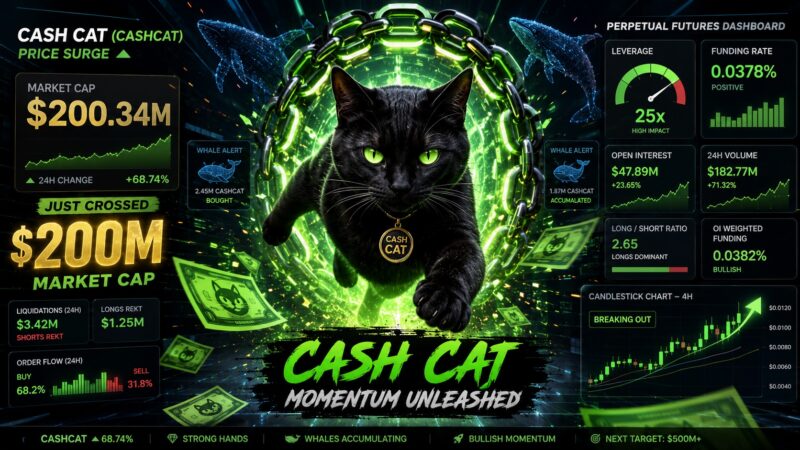
CoinGecko recently showed CASHCAT near **$0.198**, with a 24-hour range of approximately **$0.137 to $0.211**, daily trading volume around **$39 million** and a market capitalization close to **$199 million**. The token briefly reached an all-time high near **$0.2111** and ranked around No. 163 on CoinGecko at the time the data was checked.
CoinMarketCap displayed a similar price and market capitalization but a different ranking and circulating-supply estimate. These differences are common for newly launched tokens because trackers may use different liquidity sources and supply methodologies.
The rally has been extraordinary, but CASHCAT remains a memecoin with no intrinsic utility. Its value is being driven mainly by attention, liquidity and its connection to the Robinhood Chain narrative.
What Is Cash Cat?
Cash Cat is a community-created memecoin deployed on Robinhood Chain.
The name references an early mascot and naming concept associated with Robinhood before the brokerage adopted its current identity. CoinDesk described CASHCAT as being named after a mascot Robinhood used before becoming Robinhood, while the token’s own website builds its branding around that company origin story.
However, CASHCAT is **not an official Robinhood token**.
The project’s website explicitly states that it is not affiliated with Robinhood Markets or CEO Vlad Tenev. It also describes CASHCAT as a memecoin with no intrinsic value or expected financial return.
This distinction is essential. Robinhood’s history provides the narrative, but Robinhood does not provide the token with official backing, guaranteed liquidity, custody support or a future exchange listing.
Verified CASHCAT Tokenomics
The project’s website claims the following token structure:
“`text
Total supply: 1 billion CASHCAT
Buy tax: 0%
Sell tax: 0%
Initial allocation: 100% placed in the liquidity pool
Liquidity position: Project claims LP was burned
Official Robinhood Chain contract:
0x020bfc650a365f8bb26819deaabf3e21291018b4
“`
These figures are consistent with the one-billion-token maximum supply shown by major market trackers. CoinGecko recently estimated circulating supply at approximately **991.6 million CASHCAT**, while CoinMarketCap treated the entire one-billion-token supply as circulating.
The claim that liquidity was burned comes from the project itself and should not be treated as independently audited proof. Traders should verify the relevant liquidity position and contract data directly on the Robinhood Chain block explorer before relying on it.
The original draft’s claim that additional burns are funded by swap fees could not be confirmed through the project website or stronger independent sources, so it has been removed.
Robinhood Chain Is the Main Catalyst
Cash Cat’s rise is closely connected to the launch of Robinhood Chain.
Robinhood officially launched the network’s public mainnet on July 1, 2026. The company describes it as a permissionless Ethereum-compatible Layer 2 built using the Arbitrum platform and designed primarily for tokenized real-world assets, financial applications and AI-powered on-chain services.
Robinhood announced several major infrastructure partners at launch, including Uniswap, Alchemy, BitGo and Chainlink. The network also supports Robinhood-issued stock tokens and broader decentralized finance applications.
Robinhood designed the chain for financial assets—not specifically for memecoins. However, permissionless networks allow independent developers to launch tokens without corporate approval.
CASHCAT became the first major speculative asset to take advantage of that open environment.
Robinhood Chain DEX Volume Has Surged
The Cash Cat frenzy has coincided with a dramatic increase in trading activity across Robinhood Chain.
DefiLlama recently showed the network processing approximately **$611 million in 24-hour DEX volume** and around **$1.44 billion over seven days**. Its weekly DEX volume had increased by more than 13,000%, although the percentage was calculated from a very low starting base immediately after mainnet launch.
Separate reporting showed that Robinhood Chain recorded approximately **$563.9 million in DEX volume on July 8**, which was described as a network record at the time.
The figures indicate that Robinhood Chain has successfully attracted speculative liquidity during its first days. However, a significant portion of the activity appears connected to memecoin trading rather than the tokenized equities and real-world assets that form the network’s longer-term strategy.
That does not necessarily weaken the chain. Many new networks initially attract activity through speculation. The more important question is whether liquidity remains after the first memecoin cycle fades.
CASHCAT Has Become Robinhood Chain’s Flagship Memecoin
New chains often develop a dominant native memecoin.
Dogecoin represents the original meme sector. BONK became closely associated with Solana’s recovery. BRETT emerged as a prominent Base memecoin. CASHCAT is now attempting to occupy a similar position on Robinhood Chain.
CoinGecko lists Cash Cat as the largest token within its Robinhood Chain memecoin category. The token has also appeared in CoinGecko’s trending section as its market capitalization and trading volume expanded.
This “first major memecoin” status gives CASHCAT an important narrative advantage.
Traders entering Robinhood Chain frequently encounter CASHCAT first. More attention brings liquidity, liquidity attracts additional traders and rising prices strengthen the perception that CASHCAT is the network’s unofficial mascot.
This creates a reflexive cycle:
“`text
Robinhood Chain attracts new users
CASHCAT gains attention as the leading memecoin
Trading volume and liquidity increase
Price rises and attracts more social discussion
New traders bridge funds to Robinhood Chain
The chain and token reinforce each other
“`
The same cycle can reverse quickly when attention declines.
Vlad Tenev’s Meme Comment Amplified the Narrative
Robinhood CEO Vlad Tenev reportedly commented that while Robinhood Chain was being built as a leading network for real-world assets, it also worked well for memes.
The comment did not name or endorse CASHCAT. Nevertheless, traders interpreted the timing as recognition of the memecoin activity developing on the new chain. Secondary reporting linked the post to another burst of attention around CASHCAT.
The distinction between acknowledgment and endorsement is important.
A corporate executive recognizing activity on a permissionless network does not mean the company supports a particular token. Robinhood has not announced an official partnership, listing, treasury purchase or integration involving CASHCAT.
Traders should therefore avoid treating Tenev’s comment as a guarantee of future support.
Early Traders Generated Extraordinary Returns
Cash Cat’s rally has produced several viral profit stories.
CoinDesk reported that one early wallet spent approximately **$838** on 15.04 million CASHCAT. The wallet later sold most of the position for roughly $917,600 while retaining tokens worth approximately $133,700 at the time of the report.
Another wallet reportedly turned an **$85 purchase** into more than $687,000 in realized profit while holding an additional position worth around $1.2 million.
These stories are powerful marketing for a memecoin because they encourage other traders to search for similar outcomes.
However, early-wallet gains also represent distribution risk.
When investors hold millions of tokens acquired at extremely low prices, they can remain profitable even after a severe market decline. Late buyers may therefore become exit liquidity for wallets that entered before the token attracted mainstream attention.
The Ansem-Linked Whale Claim Requires Caution
Another catalyst was a large wallet purchase connected by blockchain analysts to the broader Ansem trading ecosystem.
A wallet labeled **Ansem-2** reportedly spent approximately **$233,000** to buy 2.79 million CASHCAT over several hours. The wallet was linked through on-chain activity to a Solana address holding ANSEM tokens.
However, the trader known as Ansem had not publicly confirmed ownership of the wallet at the time of the reports.
The accurate interpretation is therefore:
**A wallet labeled Ansem-2 accumulated CASHCAT and has on-chain links to an address associated by analysts with Ansem, but direct ownership remains unconfirmed.**
This activity can still influence sentiment. Large purchases increase visible demand and encourage traders to follow wallet movements. But wallet labels should not be treated as definitive identity verification.
Hyperliquid Expanded Access to CASHCAT Leverage
The addition of CASHCAT perpetual futures was another important catalyst.
CoinGecko’s market-events feed recorded a CASHCAT perpetual listing on Hyperliquid, expanding the ability of traders to take leveraged long and short positions. Reports around the launch indicated leverage of up to 3x.
CoinGlass subsequently showed approximately **$5.4 million in CASHCAT futures open interest** and more than **$16 million in derivatives trading volume**, although these numbers can change rapidly.
The listing affects CASHCAT in three ways.
First, it expands access. Traders no longer need to purchase the spot token directly to gain exposure.
Second, it improves price discovery because market participants can express both bullish and bearish views.
Third, it increases liquidation risk. Leveraged positions can be forcibly closed when price moves sharply, amplifying both rallies and declines.
Why Hyperliquid Can Increase Volatility
Perpetual futures do not require traders to own the underlying token.
A trader can open a leveraged long expecting CASHCAT to rise or a leveraged short expecting it to fall. Funding payments help keep the perpetual price aligned with the spot market.
When too many traders lean long, positive funding can make bullish positions increasingly expensive. A sudden price decline may then trigger forced liquidations, adding market sell orders and accelerating the drop.
The reverse can occur when short positions become crowded. A price breakout can force short traders to buy back exposure, creating a short squeeze.
CASHCAT’s relatively small market capitalization and limited spot-market depth make it particularly sensitive to this feedback loop.
Where CASHCAT Is Trading
CoinGecko currently identifies Uniswap V3 on Robinhood Chain as the main CASHCAT market, with the CASHCAT/WETH pair accounting for most tracked volume. MEXC has also introduced centralized spot-market access through a CASHCAT/USDT pair.
The token’s official Robinhood Chain contract is:
“`text
0x020bfc650a365f8bb26819deaabf3e21291018b4
“`
Traders should verify this address before interacting with any token.
Reports have identified other assets using the CASHCAT name on networks such as Solana. These may be unrelated tokens rather than official bridged versions. One report specifically warned that a same-name Solana deployment was not necessarily connected to the Robinhood Chain contract.
The presence of liquidity on Meteora or another Solana venue should therefore not be treated as proof of official cross-chain support without contract-level verification.
CASHCAT Technical Snapshot
Based on CoinGecko data checked during preparation:
“`text
Price: Approximately $0.198
24-hour change: Approximately +17%
24-hour range: $0.137–$0.211
All-time high: Approximately $0.2111
Market capitalization: Approximately $199 million
24-hour trading volume: Approximately $39 million
Circulating supply: Approximately 991.6 million CASHCAT
Maximum supply: 1 billion CASHCAT
CoinGecko ranking: Approximately #163
“`
These numbers are live and can change materially within minutes.
CoinMarketCap showed a price near $0.194, market capitalization near $194 million and ranking around No. 219 at a similar time, illustrating the differences between tracker methodologies.
Key CASHCAT Price Levels
The recent all-time high creates an immediate resistance zone around **$0.205–$0.215**.
A sustained breakout above that area, accompanied by strong spot volume, would indicate that buyers are accepting valuations above $200 million.
The first potential support area lies around **$0.160–$0.170**, where buyers previously entered during the latest acceleration.
The intraday low and psychological region around **$0.137–$0.140** form another important area. Losing that range could expose the earlier consolidation zone around **$0.10–$0.12**.
These are observational market zones rather than guaranteed support or price targets. CASHCAT’s short trading history makes conventional technical analysis less reliable than it would be for an established asset.
The Bullish Case for CASHCAT
The bullish case depends primarily on Robinhood Chain continuing to grow.
The network has already generated hundreds of millions of dollars in daily DEX volume and has integrations with major infrastructure providers. If more users bridge capital onto the chain, CASHCAT may continue benefiting as its leading memecoin.
Additional factors supporting the bullish thesis include:
“`text
Continued growth in Robinhood Chain users and DEX volume
CASHCAT maintaining its position as the chain’s dominant memecoin
Additional centralized exchange listings
Increasing spot-market liquidity
Further whale accumulation
Sustained social visibility
A broader market rotation into memecoins
Short squeezes through perpetual futures
“`
Because nearly all of the one-billion-token supply is already circulating, CASHCAT does not appear to face a large future vesting or token-unlock event based on current tracker data.
However, near-full circulation does not eliminate selling pressure. Existing whales can still distribute large positions.
The Bearish Case and Major Risks
CASHCAT has no fundamental token utility.
The project itself openly describes the token as having “zero utility” and no intrinsic value. Its market capitalization therefore depends almost entirely on narrative, community attention and the availability of speculative liquidity.
The major risks include:
“`text
No official affiliation with Robinhood
No underlying revenue or cash flow
Large unrealized gains held by early buyers
Limited trading history
Thin order-book depth relative to established assets
New leverage through perpetual futures
Copycat tokens using the same name
Rapid rotation of memecoin attention
Dependence on continued Robinhood Chain activity
Potential smart-contract and liquidity risks
“`
A decline of 50% or more would not be unusual for a token that has appreciated this quickly.
The addition of derivatives can make the decline faster. If long positions become crowded, a moderate price drop could trigger a liquidation cascade.
Bitcoin and the Broader Market Still Matter
CASHCAT’s move is largely token-specific, but broader crypto conditions remain important.
Bitcoin is currently trading near **$64,110**, with an intraday range of approximately $63,661 to $64,571.
If Bitcoin remains stable, traders may continue rotating capital into higher-risk assets. If BTC breaks down sharply, liquidity can quickly leave memecoins as investors reduce exposure.
CASHCAT is particularly vulnerable because its valuation has expanded much faster than the broader market. A shift from risk-on to risk-off conditions could produce a disproportionate reaction.
What Traders Should Watch Next
The first signal is Robinhood Chain DEX volume. Continued activity above several hundred million dollars per day would support the view that the network is retaining speculative liquidity.
The second signal is CASHCAT spot volume. A breakout supported by actual token purchases is more durable than one driven mainly by perpetual futures.
The third signal is Hyperliquid open interest and funding. Rapidly increasing open interest combined with highly positive funding would signal crowded long positioning.
The fourth signal is whale movement. Deposits from early wallets to exchanges or liquidity pools could indicate planned distribution.
The fifth signal is price acceptance above $0.20. CASHCAT needs more than a brief spike above this level—it needs sustained liquidity and trading activity.
The sixth signal is official Robinhood communication. Any company statement should be read carefully to distinguish general comments about memecoins from actual support for CASHCAT.
The seventh signal is contract verification. Traders should avoid same-name assets on other chains unless the Cash Cat project confirms an official bridge or deployment.
Near-Term Outlook
CASHCAT’s near-term structure remains bullish but extremely unstable.
The token has a powerful narrative: the first major memecoin on a new blockchain launched by one of the world’s best-known retail trading platforms. Robinhood Chain’s rapid growth, whale purchases and new perpetual trading access have strengthened that narrative.
However, the token is already approaching a $200 million valuation despite having no underlying utility.
The current rally can continue while attention, spot liquidity and Robinhood Chain activity remain strong. A sustained move above $0.211 could trigger another speculative expansion.
But the downside risk is equally significant.
If early wallets begin distributing, Hyperliquid longs are liquidated or Robinhood Chain volume falls, CASHCAT could retrace rapidly toward earlier price zones.
Final Thoughts
Cash Cat is the clearest expression of the current **“new chain plus native memecoin”** trade.
Robinhood Chain officially launched on July 1, and CASHCAT quickly became its first breakout speculative asset. The token’s connection to Robinhood’s early branding gives it unusually strong lore, while viral wallet profits and leveraged perpetual trading have attracted additional capital.
The central facts are clear:
CASHCAT is not affiliated with Robinhood.
It has no fundamental utility.
Its own website describes it as a memecoin with no intrinsic value.
Its near-$200 million valuation is being supported by narrative, liquidity and attention rather than protocol revenue or token-based economic activity.
That does not mean the rally must end immediately. Memecoins can continue rising far beyond valuations that appear rational.
It means the market should evaluate CASHCAT as a high-risk liquidity trade—not as an officially backed Robinhood asset.
Whether Cash Cat develops into Robinhood Chain’s long-term cultural token or becomes a short-lived launch-week phenomenon will depend on capital retention after the initial frenzy fades.
This article is for market information and educational purposes only. It is not financial advice. Memecoins carry a significant risk of rapid or total loss.