Fear & Greed Index 26 + Altcoin Season Index 51: The Market Is Still Scared, Selective, and Waiting
Crypto sentiment remains fearful while the Altcoin Season Index sits at 51. Here is why capital is rotating selectively instead of fueling a broad altseason.
Key Takeaways
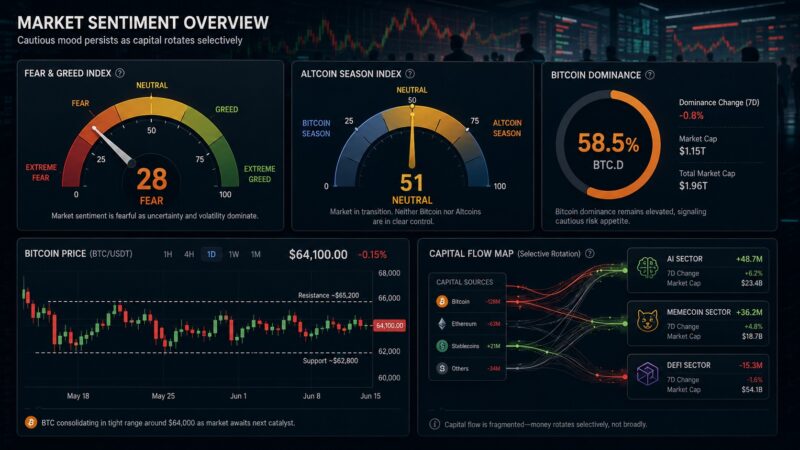
- Alternative.me’s Crypto Fear & Greed Index is at 26, while CoinMarketCap’s separate sentiment index reads 31.
- The difference is normal because the two platforms use different methodologies and market inputs.
- CoinMarketCap’s Altcoin Season Index is at 51, placing the market in a neutral transition zone rather than a confirmed altseason.
- Bitcoin dominance remains elevated at approximately 58.5%, showing that capital has not rotated broadly into altcoins.
- Bitcoin is holding near $64,000, but the Coinbase Premium Index remains negative despite improving from its June lows.
- U.S. spot Bitcoin ETF flows have alternated between inflows and outflows, indicating inconsistent institutional demand.
- The current environment is best described as selective risk-taking inside a still-fearful market.
- A broader altcoin rotation would require improving sentiment, falling Bitcoin dominance and stronger market breadth.
The market is bouncing.
Sentiment is not.
As of July 11, 2026, Alternative.me’s Crypto Fear & Greed Index stands at **26**, up from 23 yesterday, 22 one week ago and 12 one month ago. CoinMarketCap’s separate index is slightly higher at **31 out of 100**. Both readings remain firmly inside the Fear zone.
At the same time, CoinMarketCap’s Altcoin Season Index is sitting near **51**.
That is almost exactly the middle of the scale.
It is not Bitcoin Season.
It is not Altcoin Season.
It is a transition market where some assets can explode while most of the market goes nowhere.
Bitcoin dominance remains elevated at approximately **58.5%**, reinforcing the same message: liquidity is moving, but it is not spreading evenly.
This is what selective risk-on looks like inside a fearful market.
Why Alternative.me Shows 26 While CoinMarketCap Shows 31
The two Fear & Greed readings are not contradictory.
They measure different things.
Alternative.me’s index is primarily Bitcoin-focused. Its methodology combines Bitcoin volatility, market momentum and volume, social-media activity, Bitcoin dominance and search trends. The platform currently classifies 26 as Fear.
CoinMarketCap uses a broader proprietary model. Its inputs include price momentum among the top cryptocurrencies, implied volatility for Bitcoin and Ethereum, options put-call ratios, market composition and CoinMarketCap’s own social and engagement data. Its current reading is 31.
So the exact number is less important than the shared conclusion.
Both indexes say the market remains cautious.
Fear has eased.
Confidence has not fully returned.
What Fear & Greed at 26–31 Really Means
A reading in this range does not mean everyone is selling.
It means market participants are still demanding confirmation before taking more risk.
Alternative.me’s methodology specifically treats elevated volatility and drawdowns as fearful conditions. It also considers weak momentum, subdued buying volume, declining social engagement and rising Bitcoin dominance as defensive signals.
In practical terms, the current reading suggests:
“`text
Investors remain sensitive to negative headlines.
Recent gains have not triggered broad retail FOMO.
Market momentum is recovering faster than confidence.
Traders are willing to speculate, but only in selected sectors.
Capital can leave weak narratives very quickly.
“`
This is not panic.
It is hesitation.
That distinction matters.
Extreme Fear often produces indiscriminate selling. A Fear reading in the upper 20s or low 30s can instead create a market where investors cautiously test risk without committing fully.
What the Altcoin Season Index at 51 Really Means
CoinMarketCap’s Altcoin Season Index compares the 90-day performance of the top 100 eligible crypto assets against Bitcoin. Stablecoins and wrapped assets are excluded.
If at least 75% outperform Bitcoin, CoinMarketCap classifies the market as Altcoin Season. If 25% or fewer outperform Bitcoin, the market is in Bitcoin Season.
At 51, the market is almost evenly divided.
Roughly half of the eligible assets have outperformed Bitcoin over the rolling measurement period.
But that does **not** mean half of all altcoins are strong.
The index only covers the larger eligible assets. It does not capture the thousands of small tokens that may still be illiquid, inactive or trading near cycle lows.
A reading of 51 therefore means rotation is happening.
It does not mean rotation is broad enough to call an altseason.
The Two Indicators Are Telling the Same Story
Fear & Greed at 26–31 says traders remain cautious.
Altcoin Season at 51 says some capital is leaving Bitcoin for selected higher-beta assets.
Bitcoin dominance at 58.5% says most of that rotation is still not large enough to threaten Bitcoin’s market leadership.
Put them together and the market structure becomes clearer:
“`text
Sentiment: Fearful
Bitcoin leadership: Still strong
Altcoin breadth: Neutral
Speculative activity: Selective
Retail FOMO: Limited
Institutional conviction: Inconsistent
“`
This is why the market can feel dead while individual tokens rise by 50%, 100% or more.
The money is not gone.
It is concentrated.
This Is Selective Risk-On, Not Altseason
A true altseason usually has breadth.
Ethereum strengthens.
Large-cap altcoins outperform.
Mid-cap tokens follow.
Trading volume expands across multiple sectors.
Bitcoin dominance declines.
Then retail speculation reaches smaller assets.
That sequence is not fully visible today.
Instead, capital is concentrating around isolated narratives: new blockchain launches, AI-linked infrastructure, selected memecoins, on-chain derivatives ecosystems and tokens with immediate listings or protocol catalysts.
Those assets can move violently.
But their performance is not lifting the entire altcoin market.
That is the difference between **narrative rotation** and **altseason**.
Narrative rotation rewards a small group of winners.
Altseason lifts almost everything.
We are still in the first environment.
Current Crypto Market Structure
Bitcoin is trading near **$64,112**, with an intraday range of approximately $63,661 to $64,571. The asset has recovered from its early-July lows but remains inside a broader resistance battle rather than a confirmed long-term trend reversal.
CoinMarketCap currently shows:
“`text
Total crypto market capitalization: Approximately $2.2 trillion
24-hour market volume: Approximately $54 billion
Bitcoin dominance: Approximately 58.5%
Ethereum dominance: Approximately 9.9%
CoinMarketCap Fear & Greed Index: 31
“`
These figures show a market that has stabilized but is not displaying broad speculative expansion.
Bitcoin is holding.
The total market is not collapsing.
But liquidity is still too concentrated for a broad altcoin breakout.
U.S. Spot Demand Is Improving, But Still Weak
One of the most important signals is the Coinbase Premium Index.
The index compares Bitcoin pricing on Coinbase with offshore venues. A positive premium can indicate stronger buying pressure from U.S.-based investors. A negative reading indicates that Coinbase Bitcoin is trading at a discount relative to offshore markets.
CryptoQuant reported that the premium recovered from deeply negative levels to approximately **-0.062** as Bitcoin rebounded from around $57,000. That improvement suggests U.S. selling pressure has eased, but the index remains below zero and has not confirmed a durable return of U.S. spot demand.
That is an important distinction.
U.S. demand is becoming less bearish.
It is not yet convincingly bullish.
For a stronger market-wide recovery, the Coinbase Premium needs to move above zero and remain there—not simply print one temporary positive reading.
ETF Flows Are Positive in Bursts, Not in a Wave
Spot Bitcoin ETF flows are telling a similar story.
Farside Investors recorded the following total net flows:
“`text
July 1: -$296.0 million
July 2: +$223.5 million
July 6: +$265.7 million
July 7: +$21.5 million
July 8: -$84.9 million
July 9: -$95.3 million
July 10: +$90.4 million
“`
The data confirms that institutional demand can return quickly, but it has not yet become consistent.
This is not a clean institutional accumulation wave.
It is a two-way market.
Some sessions bring meaningful inflows. The next sessions give part of them back.
That pattern can support short-term Bitcoin rebounds, but it is not enough by itself to fuel a sustained market-wide risk expansion.
Why Bitcoin Can Hold While Sentiment Remains Fearful
Price and sentiment do not have to recover at the same speed.
Bitcoin can rise because shorts are covering, ETF flows briefly improve, macro pressure eases or large buyers defend support.
Sentiment indexes respond to a broader collection of inputs.
They consider volatility.
They consider momentum.
They consider market breadth.
They consider social behavior.
They consider whether capital is moving into speculative assets.
That is why Bitcoin can hold $64,000 while Fear & Greed remains below 30.
Price has improved.
The market’s trust in that improvement is still limited.
Why Some Altcoins Are Exploding Anyway
Low-confidence markets do not eliminate speculation.
They concentrate it.
When broad liquidity is weak, traders crowd into the few assets showing clear relative strength. That can make the strongest narratives rise more aggressively because less capital is being distributed across the rest of the market.
A new listing can attract leverage.
A new chain can attract memecoin liquidity.
An AI announcement can concentrate social attention.
A token unlock, buyback or protocol upgrade can become a temporary trading magnet.
The result is extreme dispersion:
“`text
A small number of assets record explosive gains.
Most large-cap altcoins remain range-bound.
Many mid-cap tokens continue underperforming.
Weak narratives lose liquidity quickly.
Short-term winners attract disproportionate social attention.
“`
This can look like the beginning of altseason.
It is not the same thing.
Altseason requires sustained breadth, not a rotating list of isolated pumps.
High Bitcoin Dominance Is Still the Main Obstacle
Bitcoin dominance around 58.5% shows that BTC continues to control most of the market’s available capital.
High dominance does not mean no altcoin can outperform.
It means altcoin strength is not yet broad enough to reduce Bitcoin’s relative share of the market significantly.
For a more convincing rotation, traders would want to see dominance establish a sustained decline below approximately **57%–58%**.
One intraday drop would not be enough.
The move would need to persist while Ethereum and the broader altcoin market gain relative strength.
Until that happens, Bitcoin remains the market’s primary liquidity anchor.
The Derivatives Market Is Not Signaling Full Euphoria
Leverage exists, but the broader Bitcoin and Ethereum derivatives market has not shown the type of extreme, uniformly positive funding associated with full speculative euphoria.
Recent institutional derivatives commentary has described BTC and ETH funding as close to neutral during periods of the current range, suggesting limited directional conviction among perpetual-futures traders. Live funding conditions can change quickly and should be checked continuously rather than treated as fixed.
That is constructive in one sense.
The Bitcoin bounce is not obviously being driven by an extreme buildup of leveraged longs.
But it also shows limited conviction.
Traders are participating.
They are not betting everything on a sustained breakout.
The Market Is Coiled, But Direction Is Not Confirmed
A fearful market holding inside a relatively tight price range creates compression.
Compression eventually resolves.
Direction is the uncertainty.
There are two main near-term paths.
Scenario One: Fear Deepens Again
Bitcoin fails to maintain the $63,000–$64,000 region.
ETF outflows return.
The Coinbase Premium remains negative.
Bitcoin dominance rises as capital exits altcoins.
Fear & Greed falls back into the teens or low 20s.
In that scenario, selective altcoin strength would likely weaken quickly. Assets that rallied primarily on social momentum or thin liquidity could experience the largest reversals.
Scenario Two: Sentiment Catches Up With Price
Bitcoin holds support and reclaims higher resistance.
ETF inflows become more consistent.
The Coinbase Premium turns positive.
Fear & Greed moves above 40.
Bitcoin dominance begins falling while Ethereum and other large-cap altcoins strengthen.
In that scenario, the current selective rotation could expand into a broader relief rally.
The second scenario is becoming more plausible as Bitcoin stabilizes, but it is not yet confirmed.
The Altcoin Season Index at 51 is the clearest warning against assuming a broad altseason has already started.
What I Am Watching Closely
1. Fear & Greed Above 40–45
A move into the 40s, combined with rising spot volume, would be the first meaningful sign that sentiment is healing rather than merely becoming less bearish.
The index does not need to reach Greed immediately.
It first needs to escape persistent Fear.
2. Altcoin Season Index Above 60–65
A move through 60–65 would suggest the rotation is broadening.
The official confirmation level remains 75, but the low-to-mid 60s would show that more large altcoins are beginning to outperform Bitcoin consistently.
3. Bitcoin Dominance Below 57%–58%
A sustained decline would indicate capital is spreading beyond BTC.
The key word is sustained.
A temporary decline caused by one large-cap altcoin rally is not enough.
4. Coinbase Premium Above Zero
The index has improved to around -0.062, but positive territory would provide stronger evidence that U.S. spot buyers are returning.
5. Consecutive ETF Inflows
One positive session is not a trend.
The market needs multiple sessions of broad inflows rather than demand concentrated in one fund or repeatedly reversed by subsequent outflows.
6. Broader Market Breadth
The most important confirmation would be strength spreading from isolated narratives into Ethereum, large-cap Layer-1 assets, DeFi tokens and eventually mid-caps.
Without breadth, the market remains a collection of individual trades rather than an altseason.
My Take as a Market Analyst
This is not a broad-beta market.
Buying a random mid-cap because “altseason is coming” remains a weak thesis.
The data does not support it yet.
Fear is still the dominant emotion.
Bitcoin dominance is still high.
U.S. spot demand is still below neutral.
ETF flows are still inconsistent.
The Altcoin Season Index is improving, but 51 is a transition reading—not a green light for indiscriminate risk.
At the same time, capital has not disappeared.
It is searching for assets with three characteristics:
“`text
A clear and timely narrative
Visible liquidity and trading volume
Relative strength against the broader market
“`
That creates opportunities.
It also creates traps.
In this environment, the strongest token can keep rising far longer than expected. The weakest token can continue declining even while social media insists that altseason has begun.
Selectivity matters more than exposure.
Confirmation matters more than prediction.
Near-Term Outlook
The near-term market outlook is neutral with an improving bias.
Bitcoin’s recovery toward $64,000 has reduced immediate breakdown risk. Fear & Greed has improved significantly from its monthly low, and the Altcoin Season Index shows that rotation is no longer completely absent.
But the evidence is incomplete.
Bitcoin dominance remains elevated.
The Coinbase Premium remains negative.
ETF flows continue moving in both directions.
Altcoin performance remains heavily concentrated around individual narratives.
That means the next major move may be sharp, but the direction still requires confirmation.
A sustained Bitcoin breakout accompanied by improving U.S. demand could lift sentiment quickly.
A rejection combined with renewed ETF outflows could return the market to deeper fear just as quickly.
Final Thoughts
Fear & Greed at 26 and the Altcoin Season Index at 51 describe a market caught between recovery and disbelief.
Investors are no longer capitulating.
They are not confident enough to chase everything either.
Bitcoin remains the primary liquidity anchor.
Altcoins are gaining ground selectively.
Institutional demand appears in short bursts.
Retail enthusiasm remains concentrated around a small number of high-beta narratives.
This is not full risk-off.
It is not full risk-on.
It is a high-dispersion market waiting for confirmation.
The market is coiled.
Sentiment is depressed but improving.
Capital is selective but still active.
The next move could be larger than the current mood suggests—but until breadth, ETF demand and U.S. spot buying improve together, patience remains more valuable than forced exposure.
Stay alert. Stay selective. Let the data confirm the narrative.
This article is for market information and educational purposes only. It should not be considered financial advice.
Internal Link Suggestions
- Bitcoin Price Faces Liquidity Shock as BTC Battles Key Technical Resistance
- FOMC Minutes Put Bitcoin Back in Focus as Fed Inflation Concerns Test BTC Rally
- Why Is Cash Cat Exploding? CASHCAT Nears $200M After Hyperliquid Listing
- AI and Blockchain in 2026: Hype, Real Utility or the Next Web3 Narrative?
- Crypto Macro Outlook 2026: Liquidity, ETF Flows and Bitcoin’s Cycle Risk